

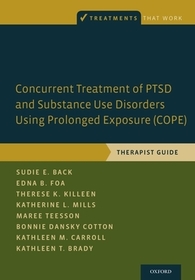
Concurrent Treatment of PTSD and Substance Use Disorders Using Prolonged Exposure (COPE)
Therapist Guide
Series: Treatments That Work;
- Publisher's listprice GBP 69.00
-
31 153 Ft (29 670 Ft + 5% VAT)
The price is estimated because at the time of ordering we do not know what conversion rates will apply to HUF / product currency when the book arrives. In case HUF is weaker, the price increases slightly, in case HUF is stronger, the price goes lower slightly.
- Discount 10% (cc. 3 115 Ft off)
- Discounted price 28 038 Ft (26 703 Ft + 5% VAT)
Subcribe now and take benefit of a favourable price.
Subscribe
31 153 Ft

Availability
printed on demand
Why don't you give exact delivery time?
Delivery time is estimated on our previous experiences. We give estimations only, because we order from outside Hungary, and the delivery time mainly depends on how quickly the publisher supplies the book. Faster or slower deliveries both happen, but we do our best to supply as quickly as possible.
Product details:
- Publisher OUP USA
- Date of Publication 20 November 2014
- ISBN 9780199334537
- Binding Paperback
- No. of pages256 pages
- Size 251x175x15 mm
- Weight 408 g
- Language English 0
Categories
Short description:
Concurrent Treatment of PTSD and Substance Use Disorders Using Prolonged Exposure (COPE) is a cognitive-behavioral psychotherapy program designed for patients who have posttraumatic stress disorder (PTSD) and a co-occurring alcohol or drug use disorder.
MoreLong description:
Concurrent Treatment of PTSD and Substance Use Disorders Using Prolonged Exposure (COPE) is a cognitive-behavioral psychotherapy program designed for patients who have posttraumatic stress disorder (PTSD) and a co-occurring alcohol or drug use disorder. COPE represents an integration of two evidence-based treatments: Prolonged Exposure (PE) therapy for PTSD and Relapse Prevention for substance use disorders.
COPE is an integrated treatment, meaning that both the PTSD and substance use disorder are addressed concurrently in therapy by the same clinician, and patients can experience substantial reductions in both PTSD symptoms and substance use severity. Patients use the COPE Patient Workbook while their clinician uses the Therapist Guide to deliver treatment. The program is comprised of 12 individual, 60 to 90 minute therapy sessions. The program includes several components: information about how PTSD symptoms and substance use interact with one another; information about the most common reactions to trauma; techniques to help the patient manage cravings and thoughts about using alcohol or drugs; coping skills to help the patient prevent relapse to substances; a breathing retraining relaxation exercise; and in vivo (real life) and imaginal exposures to target the patient's PTSD symptoms.
The COPE therapist guide and patient manual fills a tremendous need . . . Both the manual and workbook are well organised and easy to follow. . . These books raise hope that more individuals with PTSD and SUD will now have access to effective treatment for these disorders.
Table of Contents:
Chapter 1: Introductory Information for Therapists
Chapter 2: Outline of this Treatment Program
Chapter 3: Session 1: Introduction to COPE
Chapter 4: Session 2: Common Reactions to Truama and Craving Awareness
Chapter 5: Session 3: Developing the In Vivo Hierarchy and Craving Management
Chapter 6: Session 4: Initial Imaginal Exposure
Chapter 7: Session 5: Imaginal Exposure Continued and Planning and Emergencies
Chapter 8: Session 6: Imaginal Exposure Continued and Awareness of High-Risk Thoughts
Chapter 9: Session 7: Imaginal Exposure Continued and Managing High-Risk Thoughts
Chapter 10: Session 8: Imaginal Exposure Continued and Refusal Skills
Chapter 11: Session 9: Imaginal Exposure Continued and Seemingly Irrelevant Decisions (SIDs)
Chapter 12: Session 10: Imaginal Exposure Continued and Anger Awareness
Chapter 13: Session 11: Final Imaginal Exposure and Anger Management
Chapter 14: Session 12: Review and Termination
Appendix A: Information Gathering Form
Appendix B: Safety Agreement
Appendix C: Therapist Imaginal Exposure Recording Form
Appendix D: Certificate of Completion
References
About the Authors

