

- Publisher's listprice GBP 59.00
-
26 638 Ft (25 370 Ft + 5% VAT)
The price is estimated because at the time of ordering we do not know what conversion rates will apply to HUF / product currency when the book arrives. In case HUF is weaker, the price increases slightly, in case HUF is stronger, the price goes lower slightly.
- Discount 10% (cc. 2 664 Ft off)
- Discounted price 23 975 Ft (22 833 Ft + 5% VAT)
Subcribe now and take benefit of a favourable price.
Subscribe
26 638 Ft

Availability
printed on demand
Why don't you give exact delivery time?
Delivery time is estimated on our previous experiences. We give estimations only, because we order from outside Hungary, and the delivery time mainly depends on how quickly the publisher supplies the book. Faster or slower deliveries both happen, but we do our best to supply as quickly as possible.
Product details:
- Publisher OUP Oxford
- Date of Publication 22 June 2006
- ISBN 9780199297870
- Binding Hardback
- No. of pages308 pages
- Size 242x162x23 mm
- Weight 594 g
- Language English 0
Categories
Short description:
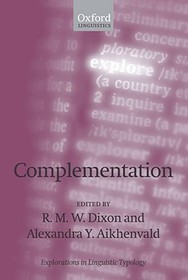
A complement clause is used instead of a noun phrase; for example one can say either I heard [the result] or I heard [that England beat France]. Languages lacking complement clauses employ complementation strategies to achieve similar semantic results. Detailed studies of particular languages, including Akkadian, Israeli, Jarawara, and Pennsylvania German, are framed by R.M. W. Dixon's introduction, which sets out the range of issues, and his conclusion, which draws together the evidence and the arguments.
MoreLong description:
A complement clause is used instead of a noun phrase; for example one can say either I heard [the result] or I heard [that England beat France]. Languages differ in the grammatical properties of complement clauses, and the types of verbs which take them. Some languages lack a complement clause construction but instead employ other construction types to achieve similar ends; these are called complementation strategies. The book explores the variety of types of complementation found across the languages of the world, their grammatical properties and meanings. Detailed studies of particular languages, including Akkadian, Israeli, Jarawara, and Pennsylvania German, are framed by R. M. W. Dixon's introduction, which sets out the range of issues, and his conclusion, which draws together the evidence and the arguments. This book will interest scholars of typology, language universals, syntax, information structure, and language contact in departments of linguistics and anthropology, as well as advanced and graduate students taking courses in these subjects.
MoreTable of Contents:
Complement Clause Types and Complementation Strategies in Typological Perspective
Complement Clause Types in Pennsylania German
Complement Clause Types in Israeli
Complement Clause Type and Complementation Strategy in Jarawara
Complement Clause Types and Complementation Strategy in White Hmong
Complement Clause Types and Complementation Strategy in Dolakha Newar
Complement Clause Types and Complementation Strategies in Akkadian
Complement Clause Types and Complementation Strategies in Tariana
Complement Clause Type and Complementation Strategies in Goemai
Complement Clause Type and Complementation Strategies in Matses
Complement Clause TYpe and Complementation Strategy in Kambera
Complementation Strategies in Dyirbal

