

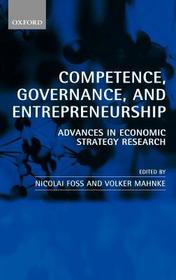
Competence, Governance, and Entrepreneurship
Advances in Economic Strategy Research
- Publisher's listprice GBP 290.00
-
130 935 Ft (124 700 Ft + 5% VAT)
The price is estimated because at the time of ordering we do not know what conversion rates will apply to HUF / product currency when the book arrives. In case HUF is weaker, the price increases slightly, in case HUF is stronger, the price goes lower slightly.
- Discount 10% (cc. 13 094 Ft off)
- Discounted price 117 842 Ft (112 230 Ft + 5% VAT)
Subcribe now and take benefit of a favourable price.
Subscribe
130 935 Ft

Availability
printed on demand
Why don't you give exact delivery time?
Delivery time is estimated on our previous experiences. We give estimations only, because we order from outside Hungary, and the delivery time mainly depends on how quickly the publisher supplies the book. Faster or slower deliveries both happen, but we do our best to supply as quickly as possible.
Product details:
- Publisher OUP Oxford
- Date of Publication 3 August 2000
- ISBN 9780198297178
- Binding Hardback
- No. of pages352 pages
- Size 242x163x24 mm
- Weight 649 g
- Language English
- Illustrations 19 figures 0
Categories
Short description:
Leading international theorists explore the most significant developments in debates on the theory of the firm - in particular the contributions of the two major perspectives: transaction costs economics (governance structures) on the one hand, and competence perspectives (resource-based approaches) on the other. Contributors include Oliver Williamson, Giovanni Dosi, Sidney Winter, Sumantra Ghoshal, Mark Casson, Neil Kay, and Ron Sanchez, amongst others.
MoreLong description:
The 'theory of the firm' is a significant part of modern economics. Because it informs strategic choices, it is highly relevant to business administration in general, and for strategic management in particular. Two dominant streams may be identified in the literature, namely the 'competence' and 'governance' perspectives on the firm. While there has been little direct discussion between the main proponents of these perspectives, both claim that they are reaching for a 'strategic theory of the firm'. Such a theory would not only shed light on the classical questions considered in the theory of the firm (e.g. why firms exist, what determines their boundaries and internal organization), but would also be helpful for informing strategy issues, such as understanding strategic flexibility, strategic options, and the sources of competitive advantage.
This volume brings together prominent voices on competence, governance, and entrepreneurship to advance and stimulate economic strategy research. By pooling and mobilizing intellectual resources of both competence and governance perspectives, the contributions show that an innovative joint venture between these two main perspectives potentially leads to a new avenue of future research on strategic issues such as 'corporate growth', 'interfirm cooperation', and 'corporate entrepreneurship'.
This book has authority ... is a well-presented and informative reference book.
Table of Contents:
Chapter 1: Introduction: Advancing Research on Competence, Governance, and Entrepreneurship
Part I: Fundamental Perspectives
Chapter 2: Strategy Research: Competence and Governance Perspectives
Chapter 3: The Knowledge-Based Approach and Organizational Economics: How much do they really Differ? And how does it Matter?
Chapter 4: On the Tangled Discourse between Transaction Cost Economics and Competence-based Views of the Firm
Part II: Firm Growth and Entrepreneurship
Chapter 5: Entrepreneurship as Element in an Evolutionary Theory of the Firm
Chapter 6: An Entrepreneurial Theory of the Firm
Chapter 7: Organizing for Firm Growth: The Interaction between Resource-Accumulating and Organizing Processes
Chapter 8: The Growth of Firms in Theory and Practice
Chapter 9: The Growth of Firms
Part III: The Dynamics of Governance
Chapter 10: Organizing for Innovation: Co-ordinating Distributed Innovation Capabilities
Chapter 11: The Role of Prior Commitment in Governance Choice
Chapter 12: Knowledge Maturity, Modularity, and the Vertical Boundaries of the Firm
Chapter 13: Inter-firm Collaboration: Contractual and Capabilities-Based Perspectives
Chapter 14: Multiple Considerations in Making Governance Choices: Implications of Transaction Cost Economics, Real Options Theory, and Knowledge-Based Theories of the Firm
Chapter 15: Demand Uncertainty and Asset Flexibility: Incorporating Strategic Options in the Theory of the Firm

