

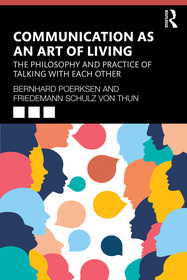
Communication as an Art of Living
The Philosophy and Practice of Talking with Each Other
- Publisher's listprice GBP 22.99
-
10 379 Ft (9 885 Ft + 5% VAT)
The price is estimated because at the time of ordering we do not know what conversion rates will apply to HUF / product currency when the book arrives. In case HUF is weaker, the price increases slightly, in case HUF is stronger, the price goes lower slightly.
- Discount 20% (cc. 2 076 Ft off)
- Discounted price 8 303 Ft (7 908 Ft + 5% VAT)
- Discount is valid until: 30 June 2026
Subcribe now and take benefit of a favourable price.
Subscribe
9 341 Ft

Availability
Not yet published.
Why don't you give exact delivery time?
Delivery time is estimated on our previous experiences. We give estimations only, because we order from outside Hungary, and the delivery time mainly depends on how quickly the publisher supplies the book. Faster or slower deliveries both happen, but we do our best to supply as quickly as possible.
Product details:
- Edition number 1
- Publisher Routledge
- Date of Publication 13 July 2026
- ISBN 9781041195993
- Binding Paperback
- No. of pages174 pages
- Size 234x156 mm
- Language English
- Illustrations 27 Illustrations, black & white; 27 Line drawings, black & white 700
Categories
Short description:
Friedemann Schulz von Thun and Bernhard Poerksen, two prominent representatives of communication psychology and media studies, provide an introduction to modern communication psychology.
More
Long description:
How can we listen better to each other? How can we offer criticism without being hurtful? Why do communication recipes never work? In this book, Friedemann Schulz von Thun and Bernhard Poerksen, two prominent representatives of communication psychology and media studies, provide an introduction to modern communication psychology.
Written in dialogic form to be both humorous and serious, this book explores questions around communication and relationships, as well as around communication and the inner self. It presents easy‑to‑understand and practical communication models that can be adapted for a variety of settings, from coaching and teaching to mediation to consultancy.
Designed to help people communicate more successfully, this engaging book will be useful for therapists, counselors, coaches, and professional groups who want to improve communication for themselves and their teams.
It will also be of interest to students of Communication Psychology and Communication Science.
“This book brings into view the programmatic core of humanistic psychology. Rather than focusing on defects, deficiencies, and pathologies, it recognizes and concentrates on opportunities for personal growth and on human potential. Bernhard Poerksen and Friedemann Schulz von Thun offer communication tools for everyone – paving the way toward better communication and perhaps also to a better life. Fascinating.”
Michael Murphy, Co-founder of Esalen Institute, the birthplace of the Human Potential Movement
MoreTable of Contents:
Praise for the German Edition
Preface
The Dialogic Principle: A Preface by Bernhard Poerksen
I. The Big Questions
1. The Communication Square
Searching for the key sentence
The power of the receiver
Hermeneutics of the listener
In praise of misunderstanding
History of an idea
Of humans and machines
Application of a model
2. Maxims of Comprehensibility
The practice of parody
The four comprehensibility dimensions
Karl Popper’s taunts
The three-world typology
The limits of communication
3. Vicious Circles and Relationship Dynamics
No beginning and no end
Victims and perpetrators
Power comes from obedience
No more either-or
The simultaneity of different things
Autonomy and dependence
The double focus
Theory and biography
4. The Ideal of Congruence
The narcissistic dilemma
The primal need of the soul
Abraham Maslow’s rant
Maximum and optimum authenticity
True to self and situation
The situation model
Higher-order sovereignty
From norm to option
Leading a congruent life
5. Communication with the Inner Self
The parallelism proposition
Self-paralysis and self-sabotage
The charisma puzzle
Stages of self-clarification
A pluralism-friendly attitude
Against exile
The power of metaphor
6. The Values Square and Views of Human Nature
The third quality
A guide to dialectical thinking
Farewell to one-sidedness
Varieties of integration
Human nature
Freedom and conditionability
Stanley Milgram’s experiment
II. The Concrete Questions
1. Communication Psychology for Managers and Executives
Double-vision consultancy
Triple pressure
The integral leader
Higher-order compromise
The values square as feedback square
Explicit and implicit meta-communication
Competition means dependence
2. Communication Psychology for Teachers
Freedom and coercion
One child’s school experience
The construction of self-images
Training the swan perspective
3. Communication Psychology and the Construction of Reality in Intercultural Communication
The ambiguous kiss
Justifying the norm
First- and second-order reality
Understanding versus refutation
III. The Last Questions
1. Happiness and Death
The end of communication
Self-determination and acceptance of fate
Vicious and virtuous circles
The certainty of uncertainty
Searching for Congruence in Communication and Life: An Afterword by Friedemann Schulz von Thun
Selected Bibliography
About the Authors
More

