

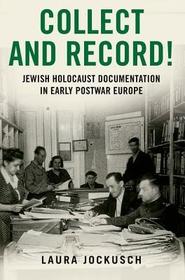
Collect and Record!
Jewish Holocaust Documentation in Early Postwar Europe
Series: Oxford Series on History and Archives;
- Publisher's listprice GBP 36.49
-
16 475 Ft (15 690 Ft + 5% VAT)
The price is estimated because at the time of ordering we do not know what conversion rates will apply to HUF / product currency when the book arrives. In case HUF is weaker, the price increases slightly, in case HUF is stronger, the price goes lower slightly.
- Discount 10% (cc. 1 648 Ft off)
- Discounted price 14 827 Ft (14 121 Ft + 5% VAT)
Subcribe now and take benefit of a favourable price.
Subscribe
16 475 Ft

Availability
printed on demand
Why don't you give exact delivery time?
Delivery time is estimated on our previous experiences. We give estimations only, because we order from outside Hungary, and the delivery time mainly depends on how quickly the publisher supplies the book. Faster or slower deliveries both happen, but we do our best to supply as quickly as possible.
Product details:
- Publisher OUP USA
- Date of Publication 20 August 2015
- ISBN 9780190259327
- Binding Paperback
- No. of pages336 pages
- Size 236x155x20 mm
- Weight 499 g
- Language English
- Illustrations 15 b/w halftones 0
Categories
Short description:
This volume tells the largely unknown story of Holocaust survivors who founded Jewish historical commissions and documentation centers in Europe immediately after World War II.
MoreLong description:
This book describes the vibrant activity of survivors who founded Jewish historical commissions and documentation centers in Europe immediately after the Second World War. In the first postwar decade, these initiatives collected thousands of Nazi documents along with testimonies, memoirs, diaries, songs, poems, and artifacts of Jewish victims. They pioneered in developing a Holocaust historiography that placed the experiences of Jews at the center and used both victim and perpetrator sources to describe the social, economic, and cultural aspects of the everyday life and death of European Jews under the Nazi regime.
This book is the first in-depth monograph on these survivor historians and the organizations they created. A comparative analysis, it focuses on France, Poland, Germany, Austria, and Italy, analyzing the motivations and rationales that guided survivors in chronicling the destruction they had witnessed, while also discussing their research techniques, archival collections, and historical publications. It reflects growing attention to survivor testimony and to the active roles of survivors in rebuilding their postwar lives. It also discusses the role of documenting, testifying, and history writing in processes of memory formation, rehabilitation, and coping with trauma.
Jockusch finds that despite differences in background and wartime experiences between the predominantly amateur historians who created the commissions, the activists found documenting the Holocaust to be a moral imperative after the war, the obligation of the dead to the living, and a means for the survivors to understand and process their recent trauma and loss. Furthermore, historical documentation was vital in the pursuit of postwar justice and was deemed essential in counteracting efforts on the part of the Nazis to erase their wartime crimes. The survivors who created the historical commissions were the first people to study the development of Nazi policy towards the Jews and also to document Jewish responses to persecution, a topic that was largely ignored by later generations of Holocaust scholars.
Table of Contents:
Note on Translations and Transliterations
List of Abbreviations
Introduction: Early Chroniclers of the Holocaust: Jewish Historical Commissions and Documentation Centers in the Aftermath of the Second World War
1. Khurbn-Forshung: History Writing as a Jewish Response to Catastrophe
2. Writing French Judaism's "Book of Martyrdom": Holocaust Documentation in Liberated France
3. Writing Polish Jewry's "Greatest National Catastrophe": Holocaust Documentation in Communist Poland
4. Writing History on Packed Suitcases: Holocaust Documentation in the Jewish Displaced Persons Camps of Germany, Austria, and Italy
Chapter 5: Joining Forces to Comprehend the Jewish Catastrophe: The Attempt to Establish a European Community of Holocaust Researchers
Conclusion: History Writing as Reconstruction: The Beginnings of Holocaust Research from the Perspective of Its Victims
Appendix: Major Participants in the Jewish Historical Commissions and Documentation Centers
Notes
Bibliography
Index

