

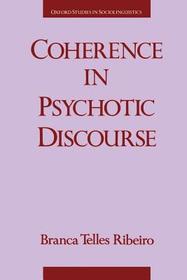
Coherence in Psychotic Discourse
Series: Oxford Studies in Sociolinguistics;
- Publisher's listprice GBP 23.99
-
10 831 Ft (10 315 Ft + 5% VAT)
The price is estimated because at the time of ordering we do not know what conversion rates will apply to HUF / product currency when the book arrives. In case HUF is weaker, the price increases slightly, in case HUF is stronger, the price goes lower slightly.
- Discount 10% (cc. 1 083 Ft off)
- Discounted price 9 748 Ft (9 284 Ft + 5% VAT)
Subcribe now and take benefit of a favourable price.
Subscribe
10 831 Ft

Availability
printed on demand
Why don't you give exact delivery time?
Delivery time is estimated on our previous experiences. We give estimations only, because we order from outside Hungary, and the delivery time mainly depends on how quickly the publisher supplies the book. Faster or slower deliveries both happen, but we do our best to supply as quickly as possible.
Product details:
- Publisher OUP USA
- Date of Publication 1 September 1994
- ISBN 9780195066159
- Binding Paperback
- No. of pages336 pages
- Size 229x156x23 mm
- Weight 544 g
- Language English
- Illustrations line drawings, tables 0
Categories
Long description:
This fascinating study explores the ways of establishing coherence in the discourse of a thought-disordered patient. Ribeiro analyses the discourse between a doctor and a patient who is under an acute psychotic crisis, and then later, when the patient is deemed recovered. Ribeiro looks at how the participants jointly establish referential meaning, and how topic coherence is achieved or breaks down. She then considers how the participants convey superordinate messages, metamessages, and how the patient signals and assesses the frame of talk. Ribeiro concludes that psychotic discourse, while incoherent on the level of topic, may be coherent on another level--that of frame. Using sociolinguistic discourse analysis, conversational analysis, and frame analysis, with a dose of theory from contemporary cognitive psychology, Ribeiro's book demonstrates the importance of contextualization in interaction.
`a significant contribution to the field of study of psychotic narrative and of discourse analysis more generally'

