

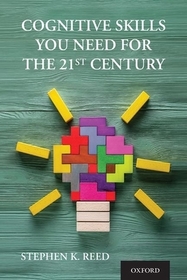
Cognitive Skills You Need for the 21st Century
- Publisher's listprice GBP 31.99
-
15 283 Ft (14 555 Ft + 5% VAT)
The price is estimated because at the time of ordering we do not know what conversion rates will apply to HUF / product currency when the book arrives. In case HUF is weaker, the price increases slightly, in case HUF is stronger, the price goes lower slightly.
- Discount 10% (cc. 1 528 Ft off)
- Discounted price 13 754 Ft (13 100 Ft + 5% VAT)
Subcribe now and take benefit of a favourable price.
Subscribe
15 283 Ft

Availability
Estimated delivery time: Expected time of arrival: end of January 2026.
Not in stock at Prospero.
Why don't you give exact delivery time?
Delivery time is estimated on our previous experiences. We give estimations only, because we order from outside Hungary, and the delivery time mainly depends on how quickly the publisher supplies the book. Faster or slower deliveries both happen, but we do our best to supply as quickly as possible.
Product details:
- Publisher OUP USA
- Date of Publication 13 August 2020
- ISBN 9780197529003
- Binding Hardback
- No. of pages300 pages
- Size 145x211x20 mm
- Weight 454 g
- Language English 87
Categories
Short description:
Cognitive Skills You Need for the 21st Century begins with a Future of Jobs report that contrasts trending and declining skills required by the workforce in the year 2022. Trending skills include analytical thinking and innovation, active learning strategies, creativity, reasoning, and complex problem solving, and Reed discusses each in detail. Research in Cognitive Psychology, Education, and AI provides the foundation for acquiring these skills. Reed presents problems and personal anecdotes to encourage reflection, and concludes with three chapters on educating 21st century skills at all levels of instruction.
MoreLong description:
In Cognitive Skills You Need for the 21st Century, Stephen Reed discusses a Future of Jobs report that contrasts trending and declining skills required by the workforce in the year 2022. Trending skills include analytical thinking and innovation, active learning strategies, creativity, reasoning, and complex problem solving. Part One on Acquiring Knowledge contains chapters on cognitive processes that are critical for learning. Part Two on Organizing Knowledge explains how matrices, networks, and hierarchies offer contrasting methods for visualizing organization. Part Three on Reasoning discusses visuospatial reasoning, reasoning from imperfect knowledge, and reasoning strategies. Part Four on Problem Solving focuses on the knowledge and strategies required to solve different types of problems, including those that involve design and dynamic changes. Part Five on Artificial Intelligence contains chapters on the Data Sciences, Explanatory Models, the Information Sciences, and General AI. Part Six on Education consists of three chapters on educating 21st century skills at all levels of instruction. Research in Cognitive Psychology, Education, and AI provides the foundation for acquiring these skills.
After helping our children during the past pandemic year with their homework, we are ready for a book offering cognitive self-help. In this work addressing the contemporary need for cross-disciplinary skills and creativity in problem-solving, Reed introduces, among other ideas, a newer more modern approach to learning mathematics. He begins by citing a study undertaken by the Educational Testing Service to determine the types of skills needed for success in the modern workforce. Key to Reed's purpose is to build connections between his own expertise in cognitive psychology and the call to understand and embrace aspects of artificial intelligence. Reed contextualizes his argument for different audiences. The book is well referenced and features an excellent index.
Table of Contents:
TOC
Preface
Introduction
Part One. Acquiring Knowledge
Chapter 1. Comprehension
Chapter 2. Action
Chapter 3. Categorization
Chapter 4. Abstraction
Part Two. Organizing Knowledge
Chapter 5. Matrices
Chapter 6. Networks
Chapter 7. Hierarchies
Part Three. Reasoning
Chapter 8. Visuospatial Reasoning
Chapter 9. Imperfect Knowledge
Chapter 10. Reasoning Strategies
Part Four. Problem Solving
Chapter 11. Problems
Chapter 12. Design
Chapter 13. Dynamics
Part Five. Artificial Intelligence
Chapter 14. Data Sciences
Chapter 15. Explainable AI
Chapter 16. Information Sciences
Chapter 17. General AI
Part Six. Education
Chapter 18. Complex Systems
Chapter 19. Computational and Mathematical Thinking
Chapter 20. Continuing Education
Notes
References

