

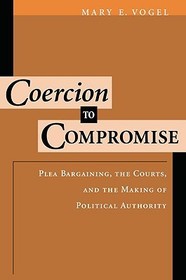
Coercion to Compromise
Plea Bargaining, the Courts, and the Making of Political Authority
Series: Oxford Socio-Legal Studies;
- Publisher's listprice GBP 38.99
-
17 603 Ft (16 765 Ft + 5% VAT)
The price is estimated because at the time of ordering we do not know what conversion rates will apply to HUF / product currency when the book arrives. In case HUF is weaker, the price increases slightly, in case HUF is stronger, the price goes lower slightly.
- Discount 10% (cc. 1 760 Ft off)
- Discounted price 15 843 Ft (15 089 Ft + 5% VAT)
Subcribe now and take benefit of a favourable price.
Subscribe
17 603 Ft

Availability
printed on demand
Why don't you give exact delivery time?
Delivery time is estimated on our previous experiences. We give estimations only, because we order from outside Hungary, and the delivery time mainly depends on how quickly the publisher supplies the book. Faster or slower deliveries both happen, but we do our best to supply as quickly as possible.
Product details:
- Edition number New ed
- Publisher OUP USA
- Date of Publication 29 November 2007
- ISBN 9780195101751
- Binding Paperback
- No. of pages448 pages
- Size 155x229x30 mm
- Weight 641 g
- Language English
- Illustrations halftones and tables 0
Categories
Short description:
This book examines the origins of the controversial practice of plea bargaining, a procedure that appears to reward the guilty. Contrary to popular perception of plea bargaining as an innovation or corruption of the post-World War II years, this study shows that the practice emerged early in ther American Republic. It argues that plea bargaining should be seen as part of a larger repertoire of techniques in the Anglo-American legal tradition through which law might be used as a vehicle of rule.
MoreLong description:
This book examines the origins of the controversial practice of plea bargaining, a procedure that appears to reward the guilty. Contrary to popular perception of plea bargainingas as an innovation or corruption of the post-World War II years, this study shows the practice to have emerged early in the American Republic. Vogel argues that plea bargaining arose in the 1830's as part of a process of political stabilization and an effort to legitimate the democratic institutions of self-rule that were crucial to Whig efforts to reconsolidate the political power of Boston's social and economic elite. At this time local political institutions were spare and fragmentary, and the courts, she argues, stepped forward as agents of the state to promote social order. Plea bargaining drew conflicts into the courts while maintaining elite discretion over sentencing policy. She argues that plea bargaining should be seen as part of a larger repertoire of techniques in the Anglo-American legal tradition through which law might be used as a vehicle of rule. In this context, plea bargaining provided a unique match between the needs of elites to maximize flexibility in criminal sanction and an emerging liberal ideology.
More
