

- Publisher's listprice GBP 15.99
-
7 219 Ft (6 875 Ft + 5% VAT)
The price is estimated because at the time of ordering we do not know what conversion rates will apply to HUF / product currency when the book arrives. In case HUF is weaker, the price increases slightly, in case HUF is stronger, the price goes lower slightly.
- Discount 20% (cc. 1 444 Ft off)
- Discounted price 5 775 Ft (5 500 Ft + 5% VAT)
- Discount is valid until: 30 June 2026
Subcribe now and take benefit of a favourable price.
Subscribe
7 219 Ft

Availability
Estimated delivery time: In stock at the publisher, but not at Prospero's office. Delivery time approx. 3-5 weeks.
Not in stock at Prospero.
Why don't you give exact delivery time?
Delivery time is estimated on our previous experiences. We give estimations only, because we order from outside Hungary, and the delivery time mainly depends on how quickly the publisher supplies the book. Faster or slower deliveries both happen, but we do our best to supply as quickly as possible.
Product details:
- Publisher Bloomsbury Publishing (UK)
- Date of Publication 26 March 2026
- Number of Volumes Paperback
- ISBN 9781472866011
- Binding Paperback
- No. of pages80 pages
- Size 246x182x10 mm
- Weight 260 g
- Language English
- Illustrations Colour artwork plates and maps; black & white and colour photographs and illustrations. 690
Categories
Short description:
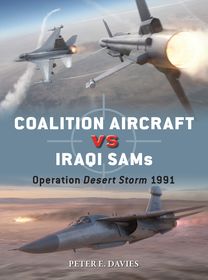
A detailed study of how Operation Desert Storm saw Coalition forces respond to Iraq's surface-to-air missile defences with ground-breaking combat aircraft technology.
MoreLong description:
A detailed study of how Operation Desert Storm saw Coalition forces respond to Iraq's surface-to-air missile defences with ground-breaking combat aircraft technology.
Developed in the wake of the USA's ill-prepared entry into the Vietnam War, aircraft carrying electronic counter-measures equipment and anti-radar missiles were crucial to the success of Operation Desert Storm during the First Gulf War. Iraq's air defence systems were elaborate and costly, but also well understood by Coalition planners, and its surface-to-air missile batteries struggled in the face of radar jamming, pyrotechnic deflection of infrared guidance and extraordinarily effective destruction of enemy air defences weapons like the AGM-88 High-speed Anti-Radiation Missile.
Written by aviation expert Peter E Davies, this fascinating study uses newly commissioned artwork to enhance its retelling of how aircraft and weapons, as well as crew training and command-and-control structures, proved decisive in the outcome of Desert Storm in 1991. Archive photos capture examples of the principal weapons involved, while first-hand accounts from Coalition aircrew and planners convey the realities of a conflict in which cutting-edge technology played an inestimable role.
Table of Contents:
Introduction
Chronology
Design and Development
Technical Specifications
The Strategic Situation
The Combatants
Combat
Statistics and Analysis
Aftermath
Further Reading
Index

