

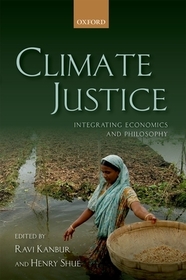
Climate Justice
Integrating Economics and Philosophy
- Publisher's listprice GBP 49.49
-
23 643 Ft (22 517 Ft + 5% VAT)
The price is estimated because at the time of ordering we do not know what conversion rates will apply to HUF / product currency when the book arrives. In case HUF is weaker, the price increases slightly, in case HUF is stronger, the price goes lower slightly.
- Discount 10% (cc. 2 364 Ft off)
- Discounted price 21 279 Ft (20 265 Ft + 5% VAT)
Subcribe now and take benefit of a favourable price.
Subscribe
23 643 Ft

Availability
printed on demand
Why don't you give exact delivery time?
Delivery time is estimated on our previous experiences. We give estimations only, because we order from outside Hungary, and the delivery time mainly depends on how quickly the publisher supplies the book. Faster or slower deliveries both happen, but we do our best to supply as quickly as possible.
Product details:
- Publisher OUP Oxford
- Date of Publication 25 October 2018
- ISBN 9780198813248
- Binding Hardback
- No. of pages278 pages
- Size 236x163x21 mm
- Weight 572 g
- Language English 0
Categories
Short description:
Climate justice requires sharing the burdens and benefits of climate change and its resolution equitably and fairly. This book brings together economic and philosophical discourse on climate justice in order to support public policy dialogue on the topic.
MoreLong description:
Climate justice requires sharing the burdens and benefits of climate change and its resolution equitably and fairly. It brings together justice between generations and justice within generations. In particular it requires that attempts to address justice between generations through various interventions designed to curb greenhouse emissions today do not end up creating injustice in our time by hurting the currently poor and vulnerable. The United Nations Sustainable Development Goals (SDGs) summit in September 2015, and the Conference of Parties (COP) to the Framework Convention on Climate Change in Paris in December 2015, brought climate change and its development impact centre stage in global discussions.
In the run up to Paris, Mary Robinson, former President of Ireland and UN Secretary General's Special Envoy for Climate Change, instituted the Climate Justice Dialogue "to mobilize political will and creative thinking to shape an ambitious and just international climate agreement in 2015". The editors of this volume, an economist and a philosopher, served on the High Level Advisory Committee of the Climate Justice Dialogue. They noted the overlap and mutual enforcement between the economic and philosophical discourses on climate justice. But they also noted the great need for these strands to come together to support the public and policy discourse. Climate Justice: Integrating Economics and Philosophy is the result.
Bringing together contributions from economists and philosophers, Climate Justice illustrates the different approaches, how they overlap and interact, and what they have already learned from each other and might still have to learn.
Table of Contents:
Climate Justice: Integrating Economics and Philosophy
Poor People on the Front Line: The Impacts of Climate Change on Poverty in 2030
Governing the Commons to Promote Global Justice: Climate Change Mitigation and Rent Taxation
Equity Implications of the COP21 Intended Nationally Determined Contributions to Reduce Greenhouse Gas Emissions
Climate Change and Inequity: How to Think about Inequities in Different Dimensions
Climate Change and Economic Self-Interest
Noncompliers' Duties
Divest-Invest: A Moral Case for Fossil Fuel Divestment
Justice and Posterity
Discounting and the Paradox of the Indefinitely Postponed Splurge
The Controllability Precautionary Principle: Justification of a Climate Policy Goal under Uncertainty
The Social Cost of Carbon from Theory to Trump
Long-term Climate Justice
Appendix: Declaration on Climate Justice

