

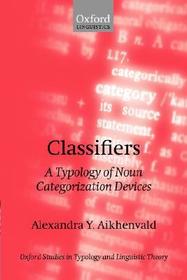
Classifiers
A Typology of Noun Categorization Devices
Series: Oxford Studies in Typology and Linguistic Theory;
- Publisher's listprice GBP 305.00
-
137 707 Ft (131 150 Ft + 5% VAT)
The price is estimated because at the time of ordering we do not know what conversion rates will apply to HUF / product currency when the book arrives. In case HUF is weaker, the price increases slightly, in case HUF is stronger, the price goes lower slightly.
- Discount 10% (cc. 13 771 Ft off)
- Discounted price 123 937 Ft (118 035 Ft + 5% VAT)
Subcribe now and take benefit of a favourable price.
Subscribe
137 707 Ft

Availability
printed on demand
Why don't you give exact delivery time?
Delivery time is estimated on our previous experiences. We give estimations only, because we order from outside Hungary, and the delivery time mainly depends on how quickly the publisher supplies the book. Faster or slower deliveries both happen, but we do our best to supply as quickly as possible.
Product details:
- Publisher OUP Oxford
- Date of Publication 30 March 2000
- ISBN 9780198238867
- Binding Hardback
- No. of pages564 pages
- Size 242x164x34 mm
- Weight 942 g
- Language English
- Illustrations Linguistic Diagrams and Tables 0
Categories
Short description:
A cross-linguistic account of noun categorization devices all over the world. The work combines original research with innovative analysis. It will interest typologists, those working in the fields of morphosyntactic variation and lexical semantics, and exponents of formal theories who wish to explain the range of linguistic diversity found in natural language.
MoreLong description:
Almost all languages have some grammatical means for the linguistic categorization of nouns. Well-known systems such as the lexical numeral classifiers of South-East Asia, on the one hand, and the highly grammaticalized gender agreement classes of Indo-European languages, on the other, are the extremes of a contiuum. They can have a similar semantic basis, and one can develop from the other.
Classifiers come in different morphological forms; they can be free nouns, clitics, or affixes. Some languages combine several varieties of classifiers. Different types of classifiers show varying correlations with other grammatical categories. In addition, they differ in their semantics, in the way they develop, and in the way they become obsolescent and disappear. These parameters are the basis for the typology of classifiers presented here.
This book is almost certainly the most substantial cross-linguistic account of classifiers ever published. Its range of exemplification includes major and minor languages from every continent (several from the author's own fieldwork).
The work combines original research with innovative analysis and will interest typologists, those working in the field of morphosyntactic variation and lexical semantics, and exponents of formal theories who wish to explain the range of linguistic diversity found in natural language.
a real treasure...highly stimulating.

