

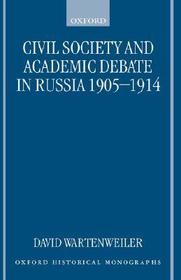
Civil Society and Academic Debate in Russia 1905-1914
Series: Oxford Historical Monographs;
- Publisher's listprice GBP 180.00
-
81 270 Ft (77 400 Ft + 5% VAT)
The price is estimated because at the time of ordering we do not know what conversion rates will apply to HUF / product currency when the book arrives. In case HUF is weaker, the price increases slightly, in case HUF is stronger, the price goes lower slightly.
- Discount 10% (cc. 8 127 Ft off)
- Discounted price 73 143 Ft (69 660 Ft + 5% VAT)
Subcribe now and take benefit of a favourable price.
Subscribe
81 270 Ft

Availability
printed on demand
Why don't you give exact delivery time?
Delivery time is estimated on our previous experiences. We give estimations only, because we order from outside Hungary, and the delivery time mainly depends on how quickly the publisher supplies the book. Faster or slower deliveries both happen, but we do our best to supply as quickly as possible.
Product details:
- Publisher OUP Oxford
- Date of Publication 15 July 1999
- ISBN 9780198207825
- Binding Hardback
- No. of pages264 pages
- Size 225x144x20 mm
- Weight 436 g
- Language English 0
Categories
Short description:
This is a study of the impact of liberal academic ideas on the concept of civil society in Russia in the years following the revolution of 1905. David Wartenweiler shows how, in its efforts to further the cause of civil society, the academic community combined liberal notions of the individual and the citizen with their own professional claim to cultural leadership.
MoreLong description:
This is a study of the impact of liberal academic ideas on the concept of civil society in Russia in the years following the revolution of 1905. The changes that resulted from the revolution were in the direction of greater autonomy for the individual and a lessening of arbitrary rule. David Wartenweiler shows how, in its efforts to further the cause of civil society, the academic community combined liberal notions of the individual and the citizen with their own professional claim to cultural leadership. Throughout an era when Russia hovered on the brink of a new revolution, academics embarked on various new enterprises - such as people's universities and private or semi-public institutions of higher education - aimed at reaching out to a wider section of the population and offering opportunities for peaceful and progressive reform.
This is an important book. Clearly written and well argued, it is essential reading for anyone interested in the history of Russian liberalism.

