

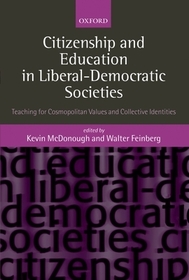
Citizenship and Education in Liberal-Democratic Societies
Teaching for Cosmopolitan Values and Collective Identities
- Publisher's listprice GBP 47.99
-
21 667 Ft (20 635 Ft + 5% VAT)
The price is estimated because at the time of ordering we do not know what conversion rates will apply to HUF / product currency when the book arrives. In case HUF is weaker, the price increases slightly, in case HUF is stronger, the price goes lower slightly.
- Discount 10% (cc. 2 167 Ft off)
- Discounted price 19 500 Ft (18 572 Ft + 5% VAT)
Subcribe now and take benefit of a favourable price.
Subscribe
21 667 Ft

Availability
printed on demand
Why don't you give exact delivery time?
Delivery time is estimated on our previous experiences. We give estimations only, because we order from outside Hungary, and the delivery time mainly depends on how quickly the publisher supplies the book. Faster or slower deliveries both happen, but we do our best to supply as quickly as possible.
Product details:
- Publisher OUP Oxford
- Date of Publication 1 December 2005
- ISBN 9780199283996
- Binding Paperback
- No. of pages464 pages
- Size 234x156x26 mm
- Weight 644 g
- Language English 0
Categories
Short description:
This book brings together essays by leading political, legal, and educational theorists to re-examine the requirements of citizenship education in liberal-democratic societies. The chapters in the book evaluate demands by minority groups for cultural recognition through education, and also examine arguments for and against citizenship education as a means of fostering a shared national identity.
MoreLong description:
The essays in this volume address the educational issues which arise when national, sub-national, and supra-national identities compete. How can we determine the limits of parental educational rights when the concern of liberalism to protect and promote children's autonomy conflicts with the desire to maintain communal integrity? Given the advances made by the forces of globalization, can the liberal-democratic state morally justify its traditional purpose of forging a cohesive national identity? Or has increasing globalization rendered this educational aim obsolete and morally corrupt? Should liberal education instead seek to foster a sense of global citizenship, even if doing so would suppress patriotic identification?
In addressing these and many other questions, the volume examines the theoretical and practical issues at stake between nationalists, multiculturalists, and cosmopolitans in the field of education. The fifteen essays, plus an introductory essay by the editors, provide a genuine, productive dialogue between political and legal philosophers and educational theorists.
This fine collection illustrates the complexity of the present contested terrain of liberal theory in philosophy of education. The authors provide such a thorough treatment of the issues that we are left asking where the debate could go from here.
Table of Contents:
Introduction: Liberalism and the Dilemma of Public Education in Multicultural Societies
Cosmopolitanism, Liberalism, and Common Education
Teaching Cosmopolitan Right
Liberal Education: The United States Example
Pluralism, Personal Identity, and Freedom of Conscience
Between State and Civil Society: European Contexts for Education
The Burdens and Dilemmas of Common Schooling
Should We Teach Patriotic History?
Liberalism and Traditionalist Education
Comprehensive Educations and the Liberal Understanding of Autonomy
Citizenship as Identity, Citizenship as Shared Fate, and the Functions of Multiculatural Education
Civic Friendship and Democratic Education
Schooling and Cultural Maintenance for Religious Minorities in the Liberal State
Liberal Constraints on Traditionalist Education
Multicultural Accomodations in Education
'Mistresses of Their Own Destiny': Group Rights, Gender, and Realistic Rights of Exit
Multinational Civic Education
Religious Education in Liberal Democratic Societies: The Question of Accountability and Autonomy
Liberalism and Group Identities

