

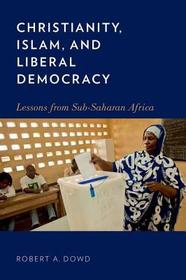
Christianity, Islam, and Liberal Democracy
Lessons from Sub-Saharan Africa
- Publisher's listprice GBP 120.00
-
54 180 Ft (51 600 Ft + 5% VAT)
The price is estimated because at the time of ordering we do not know what conversion rates will apply to HUF / product currency when the book arrives. In case HUF is weaker, the price increases slightly, in case HUF is stronger, the price goes lower slightly.
- Discount 10% (cc. 5 418 Ft off)
- Discounted price 48 762 Ft (46 440 Ft + 5% VAT)
Subcribe now and take benefit of a favourable price.
Subscribe
54 180 Ft

Availability
printed on demand
Why don't you give exact delivery time?
Delivery time is estimated on our previous experiences. We give estimations only, because we order from outside Hungary, and the delivery time mainly depends on how quickly the publisher supplies the book. Faster or slower deliveries both happen, but we do our best to supply as quickly as possible.
Product details:
- Publisher OUP USA
- Date of Publication 9 July 2015
- ISBN 9780190225216
- Binding Hardback
- No. of pages240 pages
- Size 234x157x25 mm
- Weight 635 g
- Language English
- Illustrations 17 illus. 0
Categories
Short description:
Drawing from research conducted in Nigeria, Senegal, and Uganda, Christianity, Islam, and Liberal Democracy offers a deeper understanding on how Christian and Islamic faith communities affect the political attitudes of those who belong to them.
MoreLong description:
Drawing from research conducted in Nigeria, Senegal, and Uganda, Christianity, Islam, and Liberal Democracy offers a deeper understanding on how Christian and Islamic faith communities affect the political attitudes of those who belong to them and, in turn, prospects for liberal democracy. While many analysts have thought that religious diversity in developing countries is most often an obstacle to liberal democracy that creates political instability, the book concludes just the opposite. Robert A. Dowd draws on narrative accounts, in-depth interviews, and large-scale surveys to show that Christian and Islamic religious communities are more likely to support liberal democracy in religiously diverse and integrated settings than in religiously homogeneous or segregated settings. Religious diversity, in other words, is good for liberal democracy. In religiously diverse environments, religious leaders tend to be more encouraging of civic engagement, democracy, and religious liberty. The evidence, Dowd argues, should prompt policymakers interested in cultivating religiously-inspired support for liberal democracy to aid in the formation of religiously diverse neighborhoods, cities, and political organizations.
Dowd produced a significant ground-breaking study that should stimulate other researchers to do likewise and build on his hypothesis. ... it is a text not only for those keenly interested in the nexus between religion and politics in Sub-Saharan Africa, but it is necessary reading for Africanists be they political scientists, policy makers, or religious-studies specialists.
Table of Contents:
1. Introduction: Christianity, Islam, and Liberal Democracy
2. Time, Place, and the Application of Religion to Politics
3. The Role of Religious Leaders
4. The Impact of Religious Communities
5. A Closer Look at Nigeria, Senegal, and Uganda
6. The Curious Case of Nigeria
7. Important Lessons and New Questions
Appendix A
Appendix B
Bibliography
Index

