

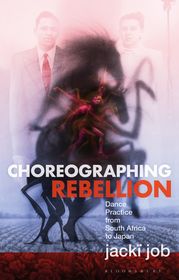
Choreographing Rebellion
Dance Practice from South Africa to Japan
- Publisher's listprice GBP 85.00
-
38 377 Ft (36 550 Ft + 5% VAT)
The price is estimated because at the time of ordering we do not know what conversion rates will apply to HUF / product currency when the book arrives. In case HUF is weaker, the price increases slightly, in case HUF is stronger, the price goes lower slightly.
- Discount 20% (cc. 7 675 Ft off)
- Discounted price 30 702 Ft (29 240 Ft + 5% VAT)
- Discount is valid until: 30 June 2026
Subcribe now and take benefit of a favourable price.
Subscribe
38 377 Ft

Availability
Not yet published.
Why don't you give exact delivery time?
Delivery time is estimated on our previous experiences. We give estimations only, because we order from outside Hungary, and the delivery time mainly depends on how quickly the publisher supplies the book. Faster or slower deliveries both happen, but we do our best to supply as quickly as possible.
Product details:
- Publisher Bloomsbury Publishing (UK)
- Date of Publication 28 May 2026
- ISBN 9781350452060
- Binding Hardback
- No. of pages184 pages
- Size 216x140x16 mm
- Weight 331 g
- Language
- Illustrations 15 b&w 700
Categories
Long description:
An auto-ethnographic account of a choreographic praxis developed outside of a Western framework, which engages with identity, decoloniality and transformation from a feminist perspective.
Choreographing Rebellion details the methodologies employed in the dramaturgy and performance of 25 choreographic works produced by the author over three decades in South Africa and Japan.
Drawing on these lived experiences, jack- job's starting point is the crafting of a signature dance language in 1994, called Daai za Lady, to respond to the oppressive and unjust socio-political system of apartheid in South Africa.
The second part speaks to choreographies created in Japan between 2003-2011, where elements of daily life and principles of Butoh are applied to making dance performance. As a South African, the author uniquely offers a first-hand understanding of Butoh in the line of Kazuo and Yoshito Ohno.
Her journey returns to South Africa, where the assimilation of Butoh into job's already existent and ongoing dance practice synergises and enables new meanings of personhood and transformation.
Choreographing Rebellion resists singular categorisations of identity too often ascribed to dance performances and communities of people. It draws on psycho-physical practices and personal philosophies of the body, which are placed in dialogue with Giorgio Agamben and Henri Bergson, and argues for the transgressing of human-centric approaches to race, gender and class through a specific animal-human crafting of dance practice.
Table of Contents:
Introduction
Chapter One: Briefly Looking Back to Move Forward
Prelude to Daai za Lady
Approaching Alternative Identities
Chapter Two: Emergence
Dawn: Birth of Daai za Lady
The Revelation of an Animist Spirit: A Matriarchal Chair, Carcasses and Masks
The Political Emergence
Chapter Three: Germination & Growth
Improvisation Techniques: Releasing Notions of Self
Japanese Codes of Daily Life: Unbuilding Western Perceptions of Structure
Enacting Love as a Strategy of Resistance
The Otherworldly Attunement of Daai za Lady's Ontology
Chapter Four: Blossoming & Fullness
Blossoming: Finding Connections through Difference
Developing New Methodologies in Performance
A Brief Note on Resisting Language
Fullness: Multiple Translations of Daai za Lady and Butoh in South Africa
Chapter Five: And Then.
Becoming the Praying Mantis
Following the Lines of Life
Looking Back at Daai za Lady
Dissipation: What Happens Next?
Bibliography
Index

