

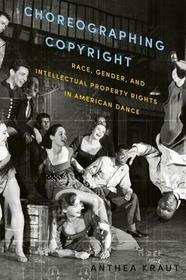
Choreographing Copyright
Race, Gender, and Intellectual Property Rights in American Dance
- Publisher's listprice GBP 145.00
-
65 467 Ft (62 350 Ft + 5% VAT)
The price is estimated because at the time of ordering we do not know what conversion rates will apply to HUF / product currency when the book arrives. In case HUF is weaker, the price increases slightly, in case HUF is stronger, the price goes lower slightly.
- Discount 10% (cc. 6 547 Ft off)
- Discounted price 58 921 Ft (56 115 Ft + 5% VAT)
Subcribe now and take benefit of a favourable price.
Subscribe
65 467 Ft

Availability
printed on demand
Why don't you give exact delivery time?
Delivery time is estimated on our previous experiences. We give estimations only, because we order from outside Hungary, and the delivery time mainly depends on how quickly the publisher supplies the book. Faster or slower deliveries both happen, but we do our best to supply as quickly as possible.
Product details:
- Publisher OUP USA
- Date of Publication 10 December 2015
- ISBN 9780199360369
- Binding Hardback
- No. of pages336 pages
- Size 160x239x25 mm
- Weight 680 g
- Language English
- Illustrations 25 photographs 0
Categories
Short description:
Choreographing Copyright Provides a historical and cultural analysis of U.S.-based dance-makers' investment in intellectual property rights.
MoreLong description:
Choreographing Copyright provides a historical and cultural analysis of U.S.-based dance-makers' investment in intellectual property rights. Although federal copyright law in the U.S. did not recognize choreography as a protectable class prior to the 1976 Copyright Act, efforts to win copyright protection for dance began eight decades earlier. In a series of case studies stretching from the late nineteenth century to the early twenty-first, the book reconstructs those efforts and teases out their raced and gendered politics. Rather than chart a narrative of progress, the book shows how dancers working in a range of genres have embraced intellectual property rights as a means to both consolidate and contest racial and gendered power.
A number of the artists featured in Choreographing Copyright are well-known white figures in the history of American dance, including modern dancers Loie Fuller, Hanya Holm, and Martha Graham, and ballet artists Agnes de Mille and George Balanchine. But the book also uncovers a host of marginalized figures - from the South Asian dancer Mohammed Ismail, to the African American pantomimist Johnny Hudgins, to the African American blues singer Alberta Hunter, to the white burlesque dancer Faith Dane - who were equally interested in positioning themselves as subjects rather than objects of property, as possessive individuals rather than exchangeable commodities. Choreographic copyright, the book argues, has been a site for the reinforcement of gendered white privilege as well as for challenges to it.
Drawing on critical race and feminist theories and on cultural studies of copyright, Choreographing Copyright offers fresh insight into such issues as: the raced and gendered hierarchies that govern the theatrical marketplace, white women's historically contingent relationship to property rights, legacies of ownership of black bodies and appropriation of non-white labor, and the tension between dance's ephemerality and its reproducibility.
Table of Contents:
Acknowledgments
Preface
Introduction: Dance Plus Copyright
Chapter One: White Womanhood and Early Campaigns for Choreographic Copyright
Chapter Two: The Black Body as Object and Subject of Property
Chapter Three: "Stealing Steps" and Signature Moves: Alternative Systems of Copyright
Chapter Four: "High-brow Meets Low-Down": Copyright on Broadway
Chapter Five: Copyright and the Death/Life of the Choreographer
Coda: Beyoncé v. De Keersmaeker
Appendix: A Timeline of Intellectual Property Rights and Dance in the United States
Select Bibliography
Index

