

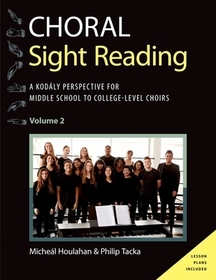
Choral Sight Reading
A Kodály Perspective for Middle School to College-Level Choirs, Volume 2
Series: Kodaly Today Handbook Series;
- Publisher's listprice GBP 25.99
-
11 734 Ft (11 175 Ft + 5% VAT)
The price is estimated because at the time of ordering we do not know what conversion rates will apply to HUF / product currency when the book arrives. In case HUF is weaker, the price increases slightly, in case HUF is stronger, the price goes lower slightly.
- Discount 20% (cc. 2 347 Ft off)
- Discounted price 9 387 Ft (8 940 Ft + 5% VAT)
- Discount is valid until: 30 June 2026
Subcribe now and take benefit of a favourable price.
Subscribe
11 734 Ft

Availability
Estimated delivery time: In stock at the publisher, but not at Prospero's office. Delivery time approx. 3-5 weeks.
Not in stock at Prospero.
Why don't you give exact delivery time?
Delivery time is estimated on our previous experiences. We give estimations only, because we order from outside Hungary, and the delivery time mainly depends on how quickly the publisher supplies the book. Faster or slower deliveries both happen, but we do our best to supply as quickly as possible.
Product details:
- Publisher OUP USA
- Date of Publication 27 March 2023
- ISBN 9780197550540
- Binding Paperback
- No. of pages376 pages
- Size 278x218x18 mm
- Weight 898 g
- Language English
- Illustrations 500 music examples 290
Categories
Short description:
Choral Sight Reading provides a practical and organic approach to teaching middle school to college level choral singing and sight-reading according to the Kodály Concept of Music Education, through a series of step-by-step practical lesson plans and instructions that can be used in choral rehearsals.
MoreLong description:
Choral Sight Reading provides a practical and organic approach to teaching choral singing and sight-reading. The text is grounded in current research from the fields of choral pedagogy, music theory, music perception and cognition. Topics include framing a choral curriculum based on the Kodály concept; launching the academic year for beginning, intermediate, and advanced choirs; building partwork skills; sight-reading; progressive music theory sequences for middle to college level choirs; teaching strategies; choral rehearsal plans as well as samples of how to teach specific repertoire from medieval to contemporary choral composers.
This volume includes basic and advanced music theory concepts to develop fluent sight-reading skills for reading standard choral repertoire, providing examples for the process outlined in Chapters 6-8 of Volume 1 (Choral Artistry). This guide provides choral directors with a choral curriculum and choral rehearsal models that place performance, audiation, partwork, music theory, and sight-signing skills at the heart of the choral experience, through a 'sound thinking' approach to teaching that results in greater efficiency in creating independent choral singers with a well-rounded repertoire.
By covering a broad range of topics, from the logistics of running a school choral program to a thoughtfully-sequenced music literacy pedagogy, Choral Artistry and Sightreading are a significant contribution to the literature, and a compelling argument for the broad application of Kodály-inspired philosophy at any level.
Table of Contents:
Unit 1 Phrase and Form
Unit 2 Beat, Meter, Rhythm
Unit 3 Simple Melodic Patterns
Unit 4 Simple Rhythm Patterns: First Division of the Beat
Unit 5 Orientation to the Pentatonic Scale: Trichord 1
Unit 6 Orientation to the Pentatonic Scale: Trichord 2
Unit 7 Simple Meter: Second Division of the Beat and Basic Patterns
Unit 8 Major Pentatonic Melodies
Unit 9 Simple Meter: Second Division of the Beat and More Complicated Patterns
Unit 10 The Extended Pentatonic Scale
Unit 11 Upbeats
Unit 12 Syncopation
Unit 13 Minor Pentatonic Melodies
Unit 14 Dotted Notes
Unit 15 Orientation to the Major Scale Pentachord and Hexachord Melodies
Unit 16 Simple Meter: Second Division of the Beat and Dotted Note Combinations
Unit 17 Major Scale
Unit 18 Triple Meter and Changing Meter
Unit 19 Orientation to Minor Scales
Unit 20 Compound Meter: First Division of the Beat
Unit 21 Natural Minor Scale
Unit 22 Compound Meter: Second Division of the Beat
Unit 23 Harmonic Minor Scale
Unit 24 Compound Meter: Second Division of the Beat and Dotted Notes
Unit 25 Melodic Minor Scale
Unit 26 Renaissance Style Compositions
Unit 27 Baroque Style Compositions
Unit 28 Classical Style Compositions
Unit 29 Romantic and Twentieth Century Style Compositions

