

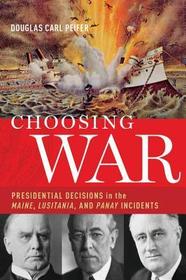
Choosing War
Presidential Decisions in the Maine, Lusitania, and Panay Incidents
- Publisher's listprice GBP 39.99
-
18 055 Ft (17 195 Ft + 5% VAT)
The price is estimated because at the time of ordering we do not know what conversion rates will apply to HUF / product currency when the book arrives. In case HUF is weaker, the price increases slightly, in case HUF is stronger, the price goes lower slightly.
- Discount 10% (cc. 1 806 Ft off)
- Discounted price 16 249 Ft (15 476 Ft + 5% VAT)
Subcribe now and take benefit of a favourable price.
Subscribe
18 055 Ft

Availability
printed on demand
Why don't you give exact delivery time?
Delivery time is estimated on our previous experiences. We give estimations only, because we order from outside Hungary, and the delivery time mainly depends on how quickly the publisher supplies the book. Faster or slower deliveries both happen, but we do our best to supply as quickly as possible.
Product details:
- Publisher OUP USA
- Date of Publication 28 July 2016
- ISBN 9780190268688
- Binding Hardback
- No. of pages344 pages
- Size 236x163x27 mm
- Weight 703 g
- Language English
- Illustrations 24 illus. 0
Categories
Short description:
This book provides the first comparative analysis of how different presidents have reacted in dissimilar manners to major international naval incidents. By examining the Maine incident, the Lusitania crisis, and the Panay incident, Douglas Carl Peifer provides an essential instrument to deal with the growing threats of a new naval crisis.
MoreLong description:
China's expanding air and naval capabilities, coupled with the proliferation of long-range anti-ship and anti-air missile systems, are making US naval diplomacy an increasingly risky enterprise. It is surprising therefore how little attention has been devoted to comparing the way in which different administrations have reacted in dissimilar manners to major naval incidents. This book provides the first comparative analysis of multiple cases. In particular, it examines three incidents: the Maine incident (1898), which led to war in the short term; the Lusitania crisis (1915), which set the trajectory for intervention; and the Panay incident (1937), which was settled diplomatically.
After scrutinizing these incidents and the domestic and international factors shaping the subsequent crisis, Douglas Carl Peifer analyses the presidential decision making in terms of options considered and policies selected. The book draws upon international relations and coercion theory but emphasizes the importance of context, complexity, and contingency when assessing presidential decision making. The contemporary tensions in East Asia, the Persian Gulf, the Baltic, and the Black Sea are increasingly vexing US naval diplomacy. By analyzing how Presidents William McKinley, Woodrow Wilson, and Franklin Delano Roosevelt responded to the Maine, Lusitania, and Panay incidents, this book provides an essential instrument to deal with the growing threats of a new naval crisis.
[A]n excellent example of how historically informed comparative analysis can create a framework for our understanding of the uses of force and war-making... The gripping prose style and narrative detail in each episode are impressive.[O]ne can only hope--likely in vain--that current policymakers will read this excellent study.
Table of Contents:
Introduction: Naval Incidents and the Decision for War
Part 1: The Maine Incident
Part 2: The Lusitania Crisis
Part 3: The Panay Incident
Conclusion: Naval Incidents and the Primacy of Context. Typologies, Theories, and the Historical Mindset
Bibliography
Index

