

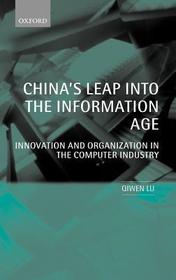
China's Leap into the Information Age
Innovation and Organization in the Computer Industry
- Publisher's listprice GBP 67.00
-
30 250 Ft (28 810 Ft + 5% VAT)
The price is estimated because at the time of ordering we do not know what conversion rates will apply to HUF / product currency when the book arrives. In case HUF is weaker, the price increases slightly, in case HUF is stronger, the price goes lower slightly.
- Discount 10% (cc. 3 025 Ft off)
- Discounted price 27 225 Ft (25 929 Ft + 5% VAT)
Subcribe now and take benefit of a favourable price.
Subscribe
30 250 Ft

Availability
printed on demand
Why don't you give exact delivery time?
Delivery time is estimated on our previous experiences. We give estimations only, because we order from outside Hungary, and the delivery time mainly depends on how quickly the publisher supplies the book. Faster or slower deliveries both happen, but we do our best to supply as quickly as possible.
Product details:
- Publisher OUP Oxford
- Date of Publication 13 July 2000
- ISBN 9780198295372
- Binding Hardback
- No. of pages228 pages
- Size 242x162x18 mm
- Weight 492 g
- Language English
- Illustrations line figures 0
Categories
Short description:
Over the last decade, China has made rapid strides to 'catch up' with the West in computer and information technologies. Qiwen Lu takes an inside look at the development of four large Chinese domestic computer enterprises (the Stone Group, the Legend Group, the Founder Group, and the China Great Wall Computer Group) from their inception to their establishment as multi-billion businesses. He shows how and why indigenous Chinese high-tech firms gained technology capabilities and modern marketing know-how, and how they were able to compete directly with Western multinationals.
MoreLong description:
This book provides the first in-depth analysis of how four innovative Chinese electronics enterprises-the Stone Group, the Legend Computer Group, the Founder Group, and the China Great Wall Computer Group-transformed the Chinese computer industry over the past decade. It explains how indigenous Chinese business enterprises that grew up during the era of economic reform gained the high-technology capabilities and modern marketing know-how to compete domestically and internationally with powerful foreign multinationals.
Through case studies based on first-hand access to company records and personnel, the author reveals how, building on technological capabilities accumulated during the central planning era, the institutional transformations of the economic reform era unleashed a unique pattern of organizational learning and innovative enterprise. The author also draws out the implications of the developmental experience of the Chinese computer electronics sector for understanding the institutional and organizational foundations for a successful transition from a centrally planned economy toward a market-oriented one.
This book scores high on both its readability and its strong conceptual underpinning ... the findings of this book are profound, in that the author discovered a unique mode of technology learning and provided strong evidence of indigenous innovative capabilities in Chinese enterprises.
Table of Contents:
Introduction
Organizational barriers to technological innovation under central planning
The development of computer technology and the IT industry in China prior to the reform
Reform of China's national science and technology system and the rise of new science and technology enterprises
Enterprise governance and mode of technology learning: an analytical framework
Chapter 1: Stone Group Co.: Turning technological potential into commercial success under a new organizational framework
Founding and early history of Stone
New institutional structure of enterprise governance
Indigenous innovation, learning, and capability acquisition: progressive integration of R&D, marketing, and manufacturing
From a new high-tech venture to an industrial going concern
Concluding remarks
Chapter 2: Legend Group Co.: A model of 'one academy, two systems'
Early history
Technological resources and managerial autonomy: relations with the Institute of Computing Technology
Technology commercialization and market expansion
Internationalization and industrialization
Continual expansion
Concluding remarks
Chapter 3: Founder Group Co.: The changing organization of innovation
The organization of large-scale industrial R&D under central planning
Entry of Founder
Relations with the university
Wellspring of innovation: indigenous capability and new organizational structure
Road to big business
Concluding remarks
Chapter 4: China Great Wall Computer Co.: Transforming the state-run computer industry
Mandarins becoming entrepreneurs: a new approach to organizing the state-run computer industry
Building integrated organizational capabilities
Corporate renewal through strategic alliances
Corporatization
Concluding remarks
Chapter 5: A New Mode of Technology Learning
Coupling between technology commercializationand non-governmentalization
New institutional structure of enterprise governance
Trajectory of learning: progressive integration of R&D, marketing, and manufacturing capabilities
Evolving structure of corporate governance
Concluding remarks

