

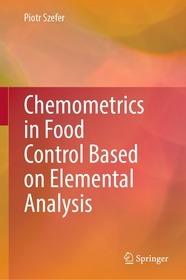
Chemometrics in Food Control Based on Elemental Analysis
-
GET 12% OFF
- Publisher's listprice EUR 181.89
-
75 438 Ft (71 846 Ft + 5% VAT)
The price is estimated because at the time of ordering we do not know what conversion rates will apply to HUF / product currency when the book arrives. In case HUF is weaker, the price increases slightly, in case HUF is stronger, the price goes lower slightly.
- Discount 12% (cc. 9 053 Ft off)
- Discounted price 66 386 Ft (63 224 Ft + 5% VAT)
66 386 Ft

Availability
printed on demand
Why don't you give exact delivery time?
Delivery time is estimated on our previous experiences. We give estimations only, because we order from outside Hungary, and the delivery time mainly depends on how quickly the publisher supplies the book. Faster or slower deliveries both happen, but we do our best to supply as quickly as possible.
Product details:
- Publisher Springer Nature Switzerland
- Date of Publication 28 January 2026
- Number of Volumes 1 pieces, Book
- ISBN 9783031996863
- Binding Hardback
- No. of pages599 pages
- Size 235x155 mm
- Language English
- Illustrations XXXV, 599 p. 202 illus., 61 illus. in color. Illustrations, black & white 691
Categories
Long description:
"
This book presents an overview of chemometric assessments of analytical dataset in order to determine the authenticity/adulteration of food, animal and plant origin, including meat, fish, seafood, milk and dairy products, honey, cereals and grains, olive oils and oilseeds, vegetables, mushrooms, fruits, tea, coffee, cocoa, sugar, mineral and drinking water, and wines and other alcoholic beverages. The text uses modern analytical methods/techniques coupled with appropriate chemometric tools to demonstrate that chemometrics is a necessary and powerful tool for food analysis and its control. Another main concern is traceability, i.e. the possibility of verifying the geographical, animal/botanical and/or productive origin of a foodstuff; hence the use of chemometric techniques is not only recommended but essential. Since the food is characterized by a complex matrix, the strategy to study its elemental profile should be multivariate. The reported data are extensively tabulated and graphically presented. This book is useful for food chemists, quality control professionals, nutrition and public health educators, analytical chemists, food manufacturers, environmental scientists and students, and practicing professions in food chemistry and food safety.
" MoreTable of Contents:
CHAPTER 1. Key Issues Constituting the Book Content.- CHAPTER 2. Meat and its Products.- CHAPTER 3. Fish Flesh.- CHAPTER 4.Seafood (Molluscs and Crustaceans).- CHAPTER 5. Milk and Dairy Products.- CHAPTER 6. Honey and its Products.- CHAPTER 7. Cereal and its Products.- CHAPTER 8. Olive Oils and Oilseeds.- CHAPTER 9. Vegetables, Legume Seeds and Spices.- CHAPTER 10. Mushrooms.- CHAPTER 11. Fruits and their Products.- CHAPTER 12. Tea and its Infusion.- CHAPTER 13. Coffee and its Infusion.- CHAPTER 14. Cocoa, Sugar and their Products.- CHAPTER 15. Mineral and Drinking Water.- CHAPTER 16. Wine and other Alcoholic Beverages.
More
