

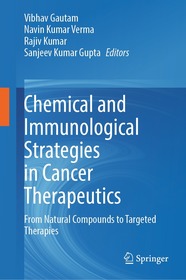
Chemical and Immunological Strategies in Cancer Therapeutics
From Natural Compounds to Targeted Therapies
- Publisher's listprice EUR 213.99
-
83 584 Ft (79 604 Ft + 5% VAT)
The price is estimated because at the time of ordering we do not know what conversion rates will apply to HUF / product currency when the book arrives. In case HUF is weaker, the price increases slightly, in case HUF is stronger, the price goes lower slightly.
- Discount 20% (cc. 16 717 Ft off)
- Discounted price 66 867 Ft (63 683 Ft + 5% VAT)
- Discount is valid until: 30 June 2026
Subcribe now and take benefit of a favourable price.
Subscribe
73 554 Ft

Availability
Not yet published.
Why don't you give exact delivery time?
Delivery time is estimated on our previous experiences. We give estimations only, because we order from outside Hungary, and the delivery time mainly depends on how quickly the publisher supplies the book. Faster or slower deliveries both happen, but we do our best to supply as quickly as possible.
Product details:
- Publisher Springer Nature Singapore
- Date of Publication 30 May 2026
- ISBN 9789819597765
- Binding Hardback
- No. of pages422 pages
- Size 235x155 mm
- Language English
- Illustrations XXIV, 422 p. 40 illus., 17 illus. in color. 700
Categories
Long description:
This contributed book provides a comprehensive exploration of chemical and immunological strategies in cancer therapeutics, emphasizing precision medicine approaches for targeted and effective treatments. It integrates cutting-edge advancements in drug discovery, covering a diverse range of anticancer agents, from natural compounds and metal-based complexes to synthetic inhibitors and nanocarriers.
The chapters cover topics such as the rational design and optimization of cancer therapeutics, employing molecular modeling, structure-activity relationship analysis, and AI-driven drug discovery. Additionally, the book highlights immunological interventions, such as immune checkpoint inhibitors and host-directed therapies, showcasing their growing relevance in personalized cancer treatment. Readers will discover diverse perspectives from expert contributing authors, offering a balanced perspective on the potential and limitations of these compounds in cancer therapeutics.
This book is intended for researchers, academics, clinicians, and industry professionals engaged in oncology, pharmacology, medicinal chemistry, and natural product research. By combining theoretical insights with practical applications, it aims to advance understanding, inspire innovation, and facilitate the translation of promising cancer therapeutics from the lab to clinical settings.
MoreTable of Contents:
1. Exploring the chemical foundations of cancer therapeutics and their historical evolution.- 2. Unveiling the structural diversity and bioactivity of natural compounds in oncology.- 3. Chemistry of plant-derived compounds like curcumin and their role in anticancer mechanisms.- 4. Distinct Chemical Scaffolds of Marine-Derived Compounds and Their Translational Potential in Targeted Cancer Therapy.- 5. Exploring the Chemical and Therapeutic Potential of Fungal Secondary Metabolites for Targeted Cancer Therapy.- 6. Chemical Approaches for Developing Potent Kinase Inhibitors and DNA-Targeting Agents in Cancer Therapy.- 7. Exploring the chemistry of platinum, ruthenium, and gold complexes in oncology.- 8. Development of Nanocarriers, Including Liposomes, Dendrimers, and Polymeric Nanoparticles, for Targeted Cancer Therapy.- 9. Enhancing the Therapeutic Efficacy of Anticancer Agents through Strategic Chemical Modification and Targeted Conjugation.- 10. Immune check point molecules and host directed therapy for cancer.- 11. Utilizing Molecular Modeling, Docking Studies, and Structure-Activity Relationship (SAR) Analysis for Optimizing Anticancer Drug Design.- 12. Techniques for synthesizing and evaluating libraries of potential anticancer agents.- 13. Advancing Targeted Cancer Therapy through AI-Driven Drug Design and CRISPR-Based Precision Targeting.- 14. Sustainable and eco-friendly approaches to drug synthesis and development.- 15. Development of Chemical Inhibitors Targeting Epigenetic Enzymes like Histone Deacetylases, DNMTs, and Bromodomains for Cancer Therapy.- 16. Small molecules inhibitors and combination therapy for cancer.- 17. Designing Metal Complexes for Cancer Targeting: Challenges and Strategies.
More
