

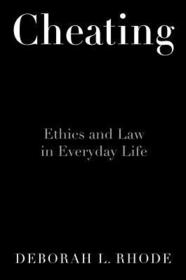
Cheating
Ethics in Everyday Life
- Publisher's listprice GBP 29.99
-
13 540 Ft (12 895 Ft + 5% VAT)
The price is estimated because at the time of ordering we do not know what conversion rates will apply to HUF / product currency when the book arrives. In case HUF is weaker, the price increases slightly, in case HUF is stronger, the price goes lower slightly.
- Discount 10% (cc. 1 354 Ft off)
- Discounted price 12 186 Ft (11 606 Ft + 5% VAT)
Subcribe now and take benefit of a favourable price.
Subscribe
13 540 Ft

Availability
printed on demand
Why don't you give exact delivery time?
Delivery time is estimated on our previous experiences. We give estimations only, because we order from outside Hungary, and the delivery time mainly depends on how quickly the publisher supplies the book. Faster or slower deliveries both happen, but we do our best to supply as quickly as possible.
Product details:
- Publisher OUP USA
- Date of Publication 4 January 2018
- ISBN 9780190672423
- Binding Hardback
- No. of pages220 pages
- Size 236x155x22 mm
- Weight 440 g
- Language English 0
Categories
Short description:
Cheating is deeply embedded in everyday life. The costs of the most common forms of cheating total close to a trillion dollars annually. With Cheating, eminent legal scholar Deborah Rhode offers the only recent comprehensive account of cheating in everyday life and the strategies necessary to address it across a wide range of contexts: sports, organizations, taxes, academia, copyright infringement, marriage, and insurance and mortgages.
MoreLong description:
Cheating is deeply embedded in everyday life. The costs of the most common forms of cheating total close to a trillion dollars annually. Part of the problem is that many individuals fail to see such behavior as a serious problem. "Everyone does it" is a common rationalization, and one that comes uncomfortably close to the truth. That perception is also self-perpetuating. The more that individuals believe that cheating is widespread, the easier it becomes to justify. Yet what is most notable about analysis of the problem is how little there is of it. Whether or not Americans are cheating more, they appear to be worrying about it less.
In Cheating, eminent legal scholar Deborah Rhode offers the only recent comprehensive account of cheating in everyday life and the strategies necessary to address it. Because cheating is highly situational, Rhode drills down on its most common forms in sports, organizations, taxes, academia, copyright infringement, marriage, and insurance and mortgages.
Cheating also reviews strategies necessary to address the pervasiveness and persistence of cheating in these contexts. We clearly need more cultural reinforcement of ethical conduct. Efforts need to begin early, with values education by parents, teachers, and other role models who can display and reinforce moral behaviors. Organizations need to create ethical cultures, in which informal norms, formal policies, and reward structures all promote integrity. People also need more moral triggers that remind them of their own values. Equally important are more effective enforcement structures, including additional resources and stiffer sanctions. Finally, all of us need to take more responsibility for combatting cheating. We need not only to subject our own conduct to more demanding standards, but also to assume a greater obligation to prevent and report misconduct. Sustaining a culture that actively discourages cheating is a collective responsibility, and one in which we all have a substantial stake.
The work as a whole is eminently readable and extremely well researched and referenced, showing a true multidisciplinary approach to a concept of high complexity. The author never gets bogged down in technicality, but keeps the text engaging to read by interspersing hard academic data with items from the news and punchy quotes from literature. It is recommended reading for professionals of many disciplines.
Table of Contents:
Chapter 1: Introduction
Chapter 2: Cheating in Sports
Chapter 3: Cheating in Organizations
Chapter 4: Cheating on Taxes
Chapter 5: Cheating in Academia
Chapter 6: Copyright Infringement
Chapter 7: Cheating in Insurance and Mortgage Applications
Chapter 8: Cheating in Marriage
Chapter 9: Conclusion

