

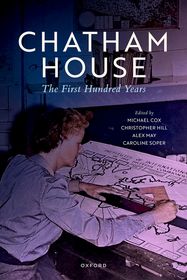
Chatham House
The First Hundred Years
- Publisher's listprice GBP 104.00
-
46 956 Ft (44 720 Ft + 5% VAT)
The price is estimated because at the time of ordering we do not know what conversion rates will apply to HUF / product currency when the book arrives. In case HUF is weaker, the price increases slightly, in case HUF is stronger, the price goes lower slightly.
- Discount 10% (cc. 4 696 Ft off)
- Discounted price 42 260 Ft (40 248 Ft + 5% VAT)
Subcribe now and take benefit of a favourable price.
Subscribe
46 956 Ft

Availability
Estimated delivery time: In stock at the publisher, but not at Prospero's office. Delivery time approx. 3-5 weeks.
Not in stock at Prospero.
Why don't you give exact delivery time?
Delivery time is estimated on our previous experiences. We give estimations only, because we order from outside Hungary, and the delivery time mainly depends on how quickly the publisher supplies the book. Faster or slower deliveries both happen, but we do our best to supply as quickly as possible.
Product details:
- Publisher OUP Oxford
- Date of Publication 5 May 2026
- ISBN 9780198984962
- Binding Hardback
- No. of pages320 pages
- Size 242x165x22 mm
- Weight 632 g
- Language English 0
Categories
Short description:
Drawing on the Institute's archives as well as public documents, secondary works, and interviews, this is a comprehensive treatment of the history and impact of Chatham House over the last 100 years.
MoreLong description:
This book is the first comprehensive treatment of the history and impact of Chatham House, also known as the Royal Institute of International Affairs, which was founded in 1920 and has been based in St. James's Square, central London, since 1923. Chatham House soon acquired a reputation as one of the world's leading think tanks on international affairs and has maintained this ever since, despite increasing competition at home and abroad. It has been a base for high-quality research as well as important meetings, including those held under the famous 'Chatham House rule', meaning that information disclosed may be used publicly but without attribution.
Chatham House covers the first 100 years of the Institute's history in three sections: between the two World Wars; the period from 1945 until the end of the Cold War; and the time from the fall of the Berlin Wall up to 2020. Using the Institute's archives as well as public documents, secondary works, and interviews where possible, the contributors have explored the main themes of Chatham House's work over the last century: empire, economic crisis and appeasement between the wars, post-war reconstruction, decolonisation, Europe and strategy after 1945, climate, identity politics, and the foreign policies of the UK and USA after 1989. The internal life of Chatham House, especially in terms of its directors and other key personalities, has also been given full attention.
Table of Contents:
Chatham House: The first hundred years
SECTION 1. Between two wars
Chatham House in the 1920s: Beginning the enterprise
Chatham House and the international crises of the 1930s
Economic dependence and interdependence: Chatham House and interwar economics
Chatham House and the empire in the interwar period
SECTION 2. The Second World War and the Cold War
Chatham House during the Second World War
Chatham House, Bretton Woods, and the United Nations system
Chatham House and decolonization, 1949-1994
Race and class in the Cold War: Chatham House and the Board of Race Relations
An insider perspective on Chatham House, 1976-1982
Chatham House and the challenges of Europe
SECTION 3. Post-1989
Chatham House and British foreign policy, 1991 to the present
From the American century to a post-American world?: Chatham House and the United States
Identity politics, Islamism, and the 'war on terror': Chatham House and alternative visions of world politics
Chatham House and the global climate crisis
A century of widening horizons: Chatham House, 1920-2020
Appendix 1: Key Chatham House office holders
Appendix 2: Biographical notes

