

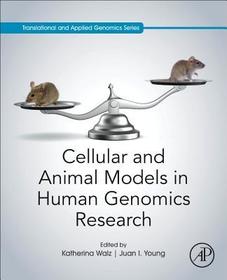
Cellular and Animal Models in Human Genomics Research
Series: Translational and Applied Genomics;
- Publisher's listprice EUR 155.00
-
60 543 Ft (57 660 Ft + 5% VAT)
The price is estimated because at the time of ordering we do not know what conversion rates will apply to HUF / product currency when the book arrives. In case HUF is weaker, the price increases slightly, in case HUF is stronger, the price goes lower slightly.
- Discount 20% (cc. 12 109 Ft off)
- Discounted price 48 434 Ft (46 128 Ft + 5% VAT)
- Discount is valid until: 30 June 2026
Subcribe now and take benefit of a favourable price.
Subscribe
60 543 Ft

Availability
printed on demand
Why don't you give exact delivery time?
Delivery time is estimated on our previous experiences. We give estimations only, because we order from outside Hungary, and the delivery time mainly depends on how quickly the publisher supplies the book. Faster or slower deliveries both happen, but we do our best to supply as quickly as possible.
Product details:
- Publisher Elsevier Science
- Date of Publication 31 July 2019
- ISBN 9780128165737
- Binding Paperback
- No. of pages226 pages
- Size 235x191 mm
- Weight 480 g
- Language English 0
Categories
Long description:
Cellular and Animal Models in Human Genomics Research provides an indispensable resource for applying comparative genomics in the annotation of disease-gene associated variants that are identified by human genomic sequencing. The book presents a thorough overview of effective protocols for the use of cellular and animal modeling methods to turn lists of plausible genes into causative biomarkers. With chapters written by international experts, the book first addresses the fundamental aspects of using cellular and animal models in genetic and genomic studies, including in-depth examples of specific models and their utility, i.e., yeast, worms, flies, fish, mice and large animals.
Protocols for properly conducting model studies, genomic technology, modeling candidate genes vs. genetic variants, integrative modeling, utilizing induced pluripotent stem cells, and employing CRISPR-Cas9 are also discussed in-depth.
MoreTable of Contents:
1. Introduction to human genetics
2. Disease in a dish: Cellular models to understand human conditions
3. Tiny models to answer big questions: The worm and the yeast as tools in human genetics research
4. Understanding human genetic disease with the fly
5. Studying human genetic variation in zebrafish
6. The mouse, a key model organism for biomedical research
7. Crispr/Cas technology
8. Integrative modeling and novel technologies in human genomics
9. Models to understand human genomics, final considerations

