

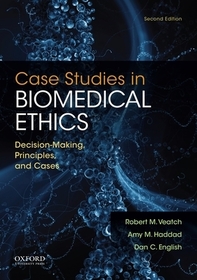
Case Studies in Biomedical Ethics
Decision-Making, Principles & Cases
- Publisher's listprice GBP 89.99
-
40 630 Ft (38 695 Ft + 5% VAT)
The price is estimated because at the time of ordering we do not know what conversion rates will apply to HUF / product currency when the book arrives. In case HUF is weaker, the price increases slightly, in case HUF is stronger, the price goes lower slightly.
- Discount 10% (cc. 4 063 Ft off)
- Discounted price 36 567 Ft (34 826 Ft + 5% VAT)
Subcribe now and take benefit of a favourable price.
Subscribe
40 630 Ft

Availability
Uncertain availability. Please turn to our customer service.
Why don't you give exact delivery time?
Delivery time is estimated on our previous experiences. We give estimations only, because we order from outside Hungary, and the delivery time mainly depends on how quickly the publisher supplies the book. Faster or slower deliveries both happen, but we do our best to supply as quickly as possible.
Product details:
- Edition number 2
- Publisher OUP USA
- Date of Publication 11 December 2014
- ISBN 9780199946563
- Binding Paperback
- No. of pages480 pages
- Size 234x165x22 mm
- Weight 748 g
- Language English 0
Categories
Short description:
The most comprehensive and up-to-date collection of its kind, Case Studies in Biomedical Ethics: Decision-Making, Principles, and Cases addresses the most critical and timely ethical issues in healthcare. Drawing on over 100 case studies from current events, court cases, and physicians' experiences, the book is divided into three parts. Part I presents a basic framework for ethical decision-making in healthcare, covering such issues as separating evaluative questions from questions of fact; distinguishing between ethical and nonethical evaluations; and identifying the source of ethical judgments.
MoreLong description:
The most comprehensive and up-to-date collection of its kind, Case Studies in Biomedical Ethics: Decision-Making, Principles, and Cases addresses the most critical and timely ethical issues in healthcare. Drawing on over 100 case studies from current events, court cases, and physicians' experiences, the book is divided into three parts. Part I presents a basic framework for ethical decision-making in healthcare, covering such issues as separating evaluative questions from questions of fact; distinguishing between ethical and nonethical evaluations; and identifying the source of ethical judgments. Expanding upon this framework, Part II explains the ethical principles: beneficence and nonmaleficence, justice, respect for autonomy, veracity, fidelity, and avoidance of killing. Parts I and II provide students with the background to analyze the ethical dilemmas presented in Part III, which features cases on a broad spectrum of issues including abortion, genetics, mental health, confidentiality, health insurance, experimentation on humans, the right to refuse treatment, and death and dying. Each case is accompanied by the authors' commentary, which guides students in considering the issues.
The new edition adds many new cases, including those at the forefront of public debate: Richard Norris (one of the first face transplant cases), The Hobby Lobby contraceptive insurance case (whether The Affordable Care Act should require employers to cover contraception and abortifacients), Terri Schiavo (the public controversy over withdrawing nutrition), and Sarah Murnaghan (the lung transplant case), and the SUPPORT study (the raging controversy over whether parents need to be informed of a randomization in the care of premature infants).
Ideal for courses in biomedical ethics, bioethics, and medical ethics.
I have found this to be an excellent textbook for my bioethics students. One of its major strengths is that it is so up to date. The authors obviously have a very strong grasp of current issues in health care today.
Table of Contents:
Table of Contents
Case Studies in Biomedical Ethics: Decision-Making, Principles, and Cases
Table of Contents
List of Cases
Preface to the Second Edition
Preface to the First Edition
Introduction: Four Questions of Ethics
What Are the Source, Meaning, and Justification of Ethical Claims?
Distinguish between Evaluative Statements and Statements Presenting Non-evaluative Facts
Distinguish between Ethical and Nonethical Evaluations
Determine Who Ought to Decide
What Kinds of Acts Are Right?
Consequentialism
Deontological or "Duty-Based " Ethics
Other Issues of Normative Ethics
Virtues: Praiseworthy Traits of Character 42 Values: Positively Evaluated Consequences
How Do Rules Apply to Specific Situations?
What Ought to Be Done in Specific Cases?
Notes
PART 1: ETHICS AND VALUES IN MEDICAL CASES
Chapter 1 A Model for Ethical Problem Solving
The Five-Step Model
Application of the Model
Notes
Chapter 2 : Values in Health and Illness
Identifying Value Judgments in Medicine
Separating Ethical and Other Evaluations
Notes
Chapter 3 : What Is the Source of Moral Judgments?
Grounding Ethics in the Professional Code
Grounding Ethics in the Physician's Orders
Grounding Ethics in Institutional Policy
Grounding Ethics in the Patient's Values
Grounding Ethics in Religious or Philosophical Perspectives
Notes
PART 2: ETHICAL PRINCIPLES IN MEDICAL ETHICS
Chapter 4 : Benefiting the Patient and Others: The Duty to Do Good and Avoid Harm
Benefiting the Patient
Health in Conflict with Other Goods
Relating Benefits and Harms
Benefits of Rules and Benefits in Specific Cases
Benefiting Society and Individuals Who Are Not Patients
Benefits to Society
Benefits to Specific Nonpatients
Benefit to the Profession
Benefit to the Health Professional and the Health Professional's Family
Notes
Chapter 5 : Justice: The Allocation of Health Resources
Justice among Patients
Justice between Patients and Others
Justice in Public Policy
Justice and Other Ethical Principles
Notes
Chapter 6 : Autonomy
Determining Whether a Patient Is Autonomous
External Constraints on Autonomy
Overriding the Choices of Autonomous Persons
Notes
Chapter 7 : Veracity: Honesty With Patients
The Condition of Doubt
Lying in order to Benefit
Protecting the Patient by Lying
Protecting the Welfare of Others
Special Cases of Truth-Telling
Patients Who Do Not Want to Be Told
Family Members Who Insist the Patient Not Be Told
The Right of Access to Medical Records
Notes
Chapter 8 : Fidelity: Promise-Keeping, Loyalty To Patients, And Impaired ProfessionalsOther Cases Involving Fidelity
The Ethics of Promises: Explicit and Implicit
Fidelity and Conflicts of Interest
Incompetent and Dishonest Colleagues
Notes
Chapter 9 : Avoidance of Killing
Active Killing versus Letting Die
Withholding versus Withdrawing Treatment
Direct versus Indirect Killing
Justifiable Omissions: The Problem of Nutrition and Hydration
Voluntary and Involuntary Killing
Killing as Punishment
Notes
PART 3: Special Problem Areas
Chapter 10 : Abortion, Sterilization, and Contraception
Abortion
Abortion for Medical Problems of the Fetus
Abortion Following Sexual Assault
Abortion to Save the Life of the Pregnant Woman
Abortion and the Mentally Incapacitated Woman
Abortion for Socioeconomic Reasons
Sterilization
Contraception
Notes
Chapter 11 : Genetics, Birth, and the Biological Revolution
Genetic Counseling
Genetic Screening
In Vitro Fertilization and Surrogate Motherhood
Preimplantation Diagnosis
Gene Therapy
Notes
Chapter 12 : Mental Health and Behavior Control
The Concept of Mental Health
Mental Illness and Autonomous Behavior
Mental Illness and Third-Party Interests
Other Behavior-Controlling Therapies
Notes
Chapter 13 : Confidentiality: Ethical Disclosure of Medical Information
Breaking Confidence to Benefit the Patient
Breaking Confidence to Benefit Others
Breaking Confidence as Required by Law
Notes
Chapter 14 : Organ Transplants
Procuring Organs
Donation versus Salvaging
The Grounds for Pronouncing Death
Diseased and Poor-Quality Organs
Preserving the Organs of the Dying
Socially Directed Organ Donation
Living Donor/Deceased Donor Organ Swaps
Children and Incompetent Persons as Living Organ Sources
Transplanting Faces and Hands: Vascular Composite Allografts
Allocating Organs
Maximizing Benefits and Distributing Organs Fairly
When Voluntary Risks Cause a Need for Organs
Age and the Allocation of Organs
Multiple Organs and Special Priority for Special People
Notes
Chapter 15 : Health Insurance, Health System Planning, and Rationing
The Problem of Small, Incremental Benefits
Limits on Unproved Therapies
Marginally Beneficial, Expensive Therapy
Funding Care that Patients Have Refused
Pharmaceutical Manufacturers versus Insurers
Insurance and the Uninsured
The Affordable Care Act
Notes
Chapter 16 : Experimentation on Human Subjects
Calculating Risks and Benefits
Privacy and Confidentiality
Equity in Research
Conflicts of Interest in Research
Informed Consent in Research
Notes
Chapter 17 : Consent and the Right to Refuse Treatment
The Elements of a Consent
The Standards for Consent
Comprehension and Voluntariness
Notes
Chapter 18 : Death and Dying
The Definition of Death
Competent and Formerly Competent Patients
Never Competent Patients
Never Competent Persons without Available Family
Never Competent Persons with Available Family
Futile Care and Limits Based on the Interests of Others
Notes
Appendix: Codes of Ethics
Glossary
List of Cases from Public Sources

