

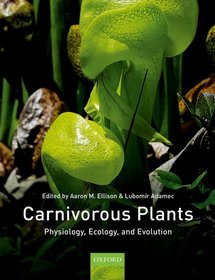
Carnivorous Plants
Physiology, ecology, and evolution
- Publisher's listprice GBP 162.50
-
73 368 Ft (69 875 Ft + 5% VAT)
The price is estimated because at the time of ordering we do not know what conversion rates will apply to HUF / product currency when the book arrives. In case HUF is weaker, the price increases slightly, in case HUF is stronger, the price goes lower slightly.
- Discount 10% (cc. 7 336 Ft off)
- Discounted price 66 032 Ft (62 888 Ft + 5% VAT)
Subcribe now and take benefit of a favourable price.
Subscribe
73 368 Ft

Availability
printed on demand
Why don't you give exact delivery time?
Delivery time is estimated on our previous experiences. We give estimations only, because we order from outside Hungary, and the delivery time mainly depends on how quickly the publisher supplies the book. Faster or slower deliveries both happen, but we do our best to supply as quickly as possible.
Product details:
- Publisher OUP Oxford
- Date of Publication 21 December 2017
- ISBN 9780198779841
- Binding Hardback
- No. of pages548 pages
- Size 252x196x29 mm
- Weight 1380 g
- Language English
- Illustrations 110 0
Categories
Short description:
This book is a synthesis of the latest research on carnivorous plants, focusing on their physiology, ecology, evolution, and future conservation and research efforts.
MoreLong description:
Carnivorous plants have fascinated botanists, evolutionary biologists, ecologists, physiologists, developmental biologists, anatomists, horticulturalists, and the general public for centuries. Charles Darwin was the first scientist to demonstrate experimentally that some plants could actually attract, kill, digest, and absorb nutrients from insect prey; his book Insectivorous Plants (1875) remains a widely-cited classic. Since then, many movies and plays, short stories, novels, coffee-table picture books, and popular books on the cultivation of carnivorous plants have been produced. However, all of these widely read products depend on accurate scientific information, and most of them have repeated and recycled data from just three comprehensive, but now long out of date, scientific monographs. The field has evolved and changed dramatically in the nearly 30 years since the last of these books was published, and thousands of scientific papers on carnivorous plants have appeared in the academic journal literature. In response, Ellison and Adamec have assembled the world's leading experts to provide a truly modern synthesis. They examine every aspect of physiology, biochemistry, genomics, ecology, and evolution of these remarkable plants, culminating in a description of the serious threats they now face from over-collection, poaching, habitat loss, and climatic change which directly threaten their habitats and continued persistence in them.
As a review of the most up to date research on carnivorous plants, this is ideal for senior undergraduate or graduate students, academics, and those with a keen interest in carnivorous plants...It rewards the careful and thorough reader who is passionate about botany.
Table of Contents:
Part I: Overview
Introduction
Biogeography and habitats of carnivorous plants
Evolution of carnivory in angiosperms
Part II: Systematics and evolution of carnivorous plants
Systematics and evolution of Droseraceae
Systematics and evolution of Nepenthes
Systematics and evolution of Lentibulariaceae: I. Pinguicula
Systematics and evolution of Lentibulariaceae: II. Genlisea
Systematics and evolution of Lentibulariaceae: III. Utricularia
Systematics and evolution of Sarraceniaceae
Systematics and evolution of small genera of carnivorous plants
Carnivorous plant genomes
Part III: Physiology, form, and function
Attraction of prey
Functional anatomy of carnivorous traps
Motile traps
Non-motile traps
Biochemistry of prey digestion and nutrient absorption
Mineral nutrition of terrestrial carnivorous plants
Why are plants carnivorous? Cost/benefit analysis, whole-plant growth, and the context- specific advantages of botanical carnivory
Ecophysiology of aquatic carnivorous plants
Biotechnology with carnivorous plants
Part IV: Ecology
Prey selection and specialization by carnivorous plants
Reproductive biology and prey-pollinator conflicts
Commensals of Nepenthes pitchers
Pitcher-plant communities as model systems for addressing fundamental questions in ecology and evolution
The Utricularia-associated microbiome: composition, function, and ecology
Nutritional mutualisms of Nepenthes and Roridula
Part V: The future of carnivorous plants
Conservation of carnivorous plants
Estimating the exposure of carnivorous plants to rapid climatic change
The future of research with carnivorous plants

