

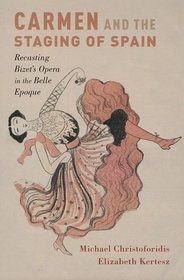
Carmen and the Staging of Spain
Recasting Bizet's Opera in the Belle Epoque
Series: Currents in Latin American and Iberian Music;
- Publisher's listprice GBP 43.49
-
19 635 Ft (18 700 Ft + 5% VAT)
The price is estimated because at the time of ordering we do not know what conversion rates will apply to HUF / product currency when the book arrives. In case HUF is weaker, the price increases slightly, in case HUF is stronger, the price goes lower slightly.
- Discount 10% (cc. 1 964 Ft off)
- Discounted price 17 672 Ft (16 830 Ft + 5% VAT)
Subcribe now and take benefit of a favourable price.
Subscribe
19 635 Ft

Availability
printed on demand
Why don't you give exact delivery time?
Delivery time is estimated on our previous experiences. We give estimations only, because we order from outside Hungary, and the delivery time mainly depends on how quickly the publisher supplies the book. Faster or slower deliveries both happen, but we do our best to supply as quickly as possible.
Product details:
- Publisher OUP USA
- Date of Publication 31 January 2019
- ISBN 9780195384567
- Binding Hardback
- No. of pages344 pages
- Size 163x236x30 mm
- Weight 680 g
- Language English
- Illustrations 75 illus. 0
Categories
Short description:
Georges Bizet's Carmen and its staging of an exoticized Spain was progressively reimagined between its 1875 Paris premiere and 1915. This book explores Carmen's dynamic interaction with Spanishness in this cosmopolitan age of spectacle, across operatic productions, parodies, and theatrical adaptations from Spain to Paris, London, and New York.
MoreLong description:
Carmen and the Staging of Spain explores the Belle Époque fascination with Spanish entertainment that refashioned Bizet's opera and gave rise to an international "Carmen industry." Authors Michael Christoforidis and Elizabeth Kertesz challenge the notion of Carmen as an unchanging exotic construct, tracing the ways in which performers and productions responded to evolving fashions for Spanish style from its 1875 premiere to 1915.
Focusing on selected realizations of the opera in Paris, London and New York, Christoforidis and Kertesz explore the cycles of influence between the opera and its parodies; adaptations in spoken drama, ballet and film; and the panorama of flamenco, Spanish dance, and musical entertainments. Their findings also uncover Carmen's dynamic interaction with issues of Hispanic identity against the backdrop of Spain's changing international fortunes.
The Spanish response to this now most-Spanish of operas is illuminated by its early reception in Madrid and Barcelona, adaptations to local theatrical genres, and impact on Spanish composers of the time. A series of Spanish Carmens, from opera singers Elena Sanz and Maria Gay to the infamous music-hall star La Belle Otero, had a crucial influence on the interpretation of the title role. Their stories provide a fresh context for the book's reappraisal of leading Carmens of the era, including Emma Calvé and Geraldine Farrar.
In the introduction to the book, Christoforidis and Kertesz write of their desire to explore 'the processes of Hispanicization' of Carmen. They have delivered in spades. This multi-faceted and potentially tangled web of the cultural and social history of Carmen is told with elegance and ease, supported by over 70 well-chosen illustrations.
Table of Contents:
Introduction
Prelude: The Spains of Paris, Mérimée and Bizet's Carmen
PART 1: CARMEN'S EARLY ESCAPADES (1875-90)
Chapter 1: Premiere and Revival: Paris, Galli-Marié and Spanish Affairs
Chapter 2: Impersonating Carmen in Victorian London
PART 2: SPAIN DISCOVERS CARMEN (1887-91)
Chapter 3: Duelling Carmens in Madrid
Chapter 4: Profusion and Parody in Barcelona
PART 3: AUTHENTICATING CARMEN IN THE AGE OF VERISMO (1889-1908)
Chapter 5: Gypsy Primitivism and the Rise of Emma Calvé
Chapter 6: Transatlantic Carmens in Dance and Drama
Chapter 7: Finding a Spanish Voice for Carmen: Elena Fons and Maria Gay
PART 4: CARMEN AS POPULAR ENTERTAINMENT (1900-15
Chapter 8: Carmen's Music Hall Embrace
Chapter 9: Reproducing Carmen in the USA: Geraldine Farrar, the Met, and Beyond

