

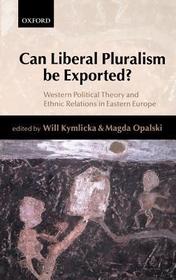
Can Liberal Pluralism be Exported?
Western Political Theory and Ethnic Relations in Eastern Europe
- Publisher's listprice GBP 157.50
-
71 111 Ft (67 725 Ft + 5% VAT)
The price is estimated because at the time of ordering we do not know what conversion rates will apply to HUF / product currency when the book arrives. In case HUF is weaker, the price increases slightly, in case HUF is stronger, the price goes lower slightly.
- Discount 10% (cc. 7 111 Ft off)
- Discounted price 64 000 Ft (60 953 Ft + 5% VAT)
Subcribe now and take benefit of a favourable price.
Subscribe
71 111 Ft

Availability
printed on demand
Why don't you give exact delivery time?
Delivery time is estimated on our previous experiences. We give estimations only, because we order from outside Hungary, and the delivery time mainly depends on how quickly the publisher supplies the book. Faster or slower deliveries both happen, but we do our best to supply as quickly as possible.
Product details:
- Publisher OUP Oxford
- Date of Publication 17 January 2002
- ISBN 9780199240630
- Binding Hardback
- No. of pages458 pages
- Size 241x163x29 mm
- Weight 822 g
- Language English 0
Categories
Short description:
Many post-communist countries in Central/Eastern Europe and the former Soviet Union are being encouraged and indeed pressured by Western countries to improve their treatment of ethnic and national minorities, and to adopt Western models of minority rights. But what are these Western models, and will they work in Eastern Europe? In the first half of this volume, Will Kymlicka describes a model of 'liberal pluralism' which has gradually emerged in most Western democracies, and discusses what would be involved in adopting it in Eastern Europe. This is followed by 15 commentaries from people actively involved in minority rights issues in the region, as practitioners or academics, and by Kymlicka's reply. This volume will be of
interest to anyone concerned with ethnic conflict in Eastern Europe, and with the more general question of whether Western liberal values can or should be promoted in the rest of the world.
Long description:
Many post-communist countries in Central/Eastern Europe and the former Soviet Union are being encouraged and indeed pressured by Western countries to improve their treatment of ethnic and national minorities, and to adopt Western models of minority rights. But what are these Western models, and will they work in Eastern Europe? In the first half of this volume, Will Kymlicka describes a model of 'liberal pluralism' which has gradually emerged in most Western democracies, and discusses what would be involved in adopting it in Eastern Europe. This is followed by 15 commentaries from people actively involved in minority rights issues in the region, as practitioners or academics, and by Kymlicka's reply. This volume will be of
interest to anyone concerned with ethnic conflict in Eastern Europe, and with the more general question of whether Western liberal values can or should be promoted in the rest of the world.
An important and very interesting volume on a topic of great contemporary significance ... This is a very successful volume ... The book as a whole is an exciting venture in the field of applying normative ideas to an often refractory and complex social reality.
Table of Contents:
Introduction
Part 1: A Western Political Theory and Ethnic Relations in Eastern Europe
Part 2: Commentaries
Liberal Pluralism and Post-Communism
Rethinking the State and National Security in Eastern Europe
On the Chances of Ethnocultural Justice in East-Central Europe
Nation-States and Immigrant Societies
New Democracies in the Old World
Some Doubts about `Ethnocultural Justice
Reflections on Minority Rights Politics for East Central European Countries
Territorial Autonomy as a Minority Rights Regime in Post-Communist Countries
Nation-Building and Beyond
Ethnocultural Justice in East European States and the Case of the Czech Roma
Definitions and Discourse: Applying Kymlickas Models to Estonia and Latvia
Universal Thought, Eastern Facts: Scrutinizing National Minority Rights in Romania
Perspectives on a Liberal-Pluralist Approach to Ethnic Minorities in Ukraine
Can Liberal Nationalities Policy be Implemented in Post-Soviet Russia?
Nation-Building, Culture and Problems of Ethnocultural Identity in Central Asia: The Case of Uzbekistan
Part 3. Reply and Conclusion

