

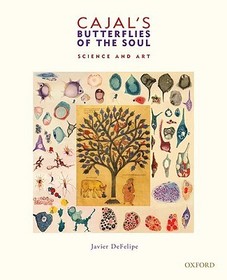
Cajal's Butterflies of the Soul
Science and Art
- Publisher's listprice GBP 130.00
-
58 695 Ft (55 900 Ft + 5% VAT)
The price is estimated because at the time of ordering we do not know what conversion rates will apply to HUF / product currency when the book arrives. In case HUF is weaker, the price increases slightly, in case HUF is stronger, the price goes lower slightly.
- Discount 10% (cc. 5 870 Ft off)
- Discounted price 52 826 Ft (50 310 Ft + 5% VAT)
Subcribe now and take benefit of a favourable price.
Subscribe
58 695 Ft

Availability
printed on demand
Why don't you give exact delivery time?
Delivery time is estimated on our previous experiences. We give estimations only, because we order from outside Hungary, and the delivery time mainly depends on how quickly the publisher supplies the book. Faster or slower deliveries both happen, but we do our best to supply as quickly as possible.
Product details:
- Publisher OUP USA
- Date of Publication 19 November 2009
- Number of Volumes Hardback
- ISBN 9780195392708
- Binding Hardback
- No. of pages424 pages
- Size 289x235x22 mm
- Weight 1547 g
- Language English
- Illustrations 57 illustrations 0
Categories
Long description:
This book contains a large collection of beautiful figures produced throughout the nineteenth century and the beginning of the twentieth century and that represent some characteristic examples of the early days of research in neuroscience. The main aim of this work is to demonstrate to the general public that the study of the nervous system is not only important for the many obvious reasons related to brain function in both health and disease, but also for the unexpected natural beauty that it beholds. This beauty has been discovered thanks to the techniques used to visualize the microscopic structure of the brain, a true forest of colourful and florid neural cells. As illustrated by his marvellous drawings, the studies of Santiago Ramón y Cajal (1852-1934) no doubt contributed more than those of any other researcher at the time to the growth of modern neuroscience. Thus, we have honored his name in the title of this book, even though the figures contained in the main body of the book are from 91 authors. Looking at the illustrations in this book the readers will not only marvel at Cajal's drawings but they will also find that many of the other early researchers that studied the nervous system were also true artists, of considerable talent and aesthetic sensibility. Thus, the present book contains numerous drawings of some of the most important pioneers in neuroscience, including Deiters, Kölliker, Meynert, Ranvier, Golgi, Retzius, Nissl, Dogiel, Alzheimer, del Río-Hortega and de Castro.
The book has been divided into two Parts, Part I and II, the latter containing the main body of the work. Part I contains introductory information that will give readers unfamiliar with the nervous system a better understanding of the importance of the scientific illustrations produced in those days. The second part of the book, Part II, contains the collection of 282 figures with the intention of transforming the reader into an observer. These illustrations have been divided in three main categories: Section I, The Benedictine period: The early days; Section II, The black period: Neurons, glia and organization of the nervous system; Section III, The colourful period: internal structure and chemistry of the cells.
This book will be of general interest, not only due to the captivating aesthetic appeal of the illustrations but also because they represent the bases of our current understanding of the nervous system. The reader will find that many of the illustrations can be considered to belong to different artistic movements, such as modernism, surrealism, cubism, abstract art or impressionism. Indeed, these illustrations may also provide artists with a source of inspiration since they reveal a fantastic and virtually unknown world of forms, a microuniverse with an aura of mystery.
Javier DeFelipe should be congratulated on assembling such a beautiful book about the earliest microscopic investigations of the nervous system conducated at the end of the 19th century and early 20th century...This book is a wonderful addition to the library of any neuroscientist or neurologist. It is worthy of attention of artists who enjoy the beauty of the natural world.

