

- Publisher's listprice GBP 64.00
-
30 576 Ft (29 120 Ft + 5% VAT)
The price is estimated because at the time of ordering we do not know what conversion rates will apply to HUF / product currency when the book arrives. In case HUF is weaker, the price increases slightly, in case HUF is stronger, the price goes lower slightly.
- Discount 10% (cc. 3 058 Ft off)
- Discounted price 27 518 Ft (26 208 Ft + 5% VAT)
Subcribe now and take benefit of a favourable price.
Subscribe
30 576 Ft

Availability
Estimated delivery time: In stock at the publisher, but not at Prospero's office. Delivery time approx. 3-5 weeks.
Not in stock at Prospero.
Why don't you give exact delivery time?
Delivery time is estimated on our previous experiences. We give estimations only, because we order from outside Hungary, and the delivery time mainly depends on how quickly the publisher supplies the book. Faster or slower deliveries both happen, but we do our best to supply as quickly as possible.
Product details:
- Publisher Indiana University Press
- Date of Publication 7 June 2022
- Number of Volumes Print PDF
- ISBN 9780253061867
- Binding Hardback
- No. of pages276 pages
- Size 229x152 mm
- Weight 726 g
- Language English
- Illustrations 90 color illus., 2 b&w tables Illustrations, color 218
Categories
Long description:
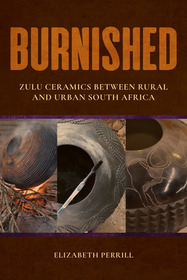
When Zulu women potters innovate or move to a more urban setting, they are asked why they have abandoned tradition. Yet when they continue to follow convention or choose to stay in rural areas, art historians speak of their work as unchanging symbols of the past. Burnished rejects both stereotypes, acknowledging the agency of rural women as innovative artists and complex individuals negotiating a biased set of power structures.
Featuring 90 color images, Burnished engages directly with individual artists and specific vessels, fracturing assumptions that Zulu ceramicists are resistant to rural transformation and insulated from urban realities. Elizabeth Perrill shares compelling narratives of women ceramic artists and the sophisticated beer pots they create—their aesthetic choices, audiences, production, and artistic lives. Simultaneously, Perrill documents the manner in which and reasons why ceramic arts, and at times the artists themselves, capitalize upon bucolic stereotypes of rural womanhood, are constrained by artistic methods, or chafe against definitions of what qualifies as a Zulu pot.
Revealing how white South Africans and global art gatekeepers have continually twisted the designation of Zulu ceramics before, during, and after apartheid, Burnished provides an engaging look at the artistry of entrepreneurial Black women too often erased from historical records.

