

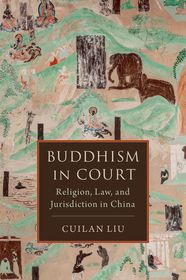
Buddhism in Court
Religion, Law, and Jurisdiction in China
- Publisher's listprice GBP 78.00
-
35 217 Ft (33 540 Ft + 5% VAT)
The price is estimated because at the time of ordering we do not know what conversion rates will apply to HUF / product currency when the book arrives. In case HUF is weaker, the price increases slightly, in case HUF is stronger, the price goes lower slightly.
- Discount 20% (cc. 7 043 Ft off)
- Discounted price 28 174 Ft (26 832 Ft + 5% VAT)
- Discount is valid until: 30 June 2026
Subcribe now and take benefit of a favourable price.
Subscribe
35 217 Ft

Availability
Estimated delivery time: In stock at the publisher, but not at Prospero's office. Delivery time approx. 3-5 weeks.
Not in stock at Prospero.
Why don't you give exact delivery time?
Delivery time is estimated on our previous experiences. We give estimations only, because we order from outside Hungary, and the delivery time mainly depends on how quickly the publisher supplies the book. Faster or slower deliveries both happen, but we do our best to supply as quickly as possible.
Product details:
- Publisher OUP USA
- Date of Publication 29 August 2024
- ISBN 9780197663332
- Binding Hardback
- No. of pages288 pages
- Size 236x130x33 mm
- Weight 680 g
- Language English
- Illustrations 8 533
Categories
Short description:
Buddhism in Court is the first English language study of the legal interaction between Buddhism and the state in China. It uncovers a long-overlooked Buddhist campaign for clerical legal privileges that aimed to make ordained Buddhist monks and nuns immune from facing trials and punishment in the state court.
MoreLong description:
What happens to Buddhist monks and nuns who commit crimes? Buddhism in Court is the first book to uncover an important, yet long-overlooked, Buddhist campaign for clerical legal privileges that aim to exempt monks and nuns from being tried and punished in the government courts. Liu reveals the campaign's origins in Indian Buddhism and how Chinese Buddhists' engagement reshaped Buddhism's place in the jurisdictional landscape in China from the fourth century to the present.
Drawing on Buddhist monastic law texts, archives, court documents, Chinese laws, official histories, law case books, institutional announcements, and private writings circulated on social media, Buddhism in Court traces the legacy of the campaign for clerical legal privileges from its origin in India to its transformation in China and its continuing impact in the Chinese courtroom to the present day. Diverting from the dynasty-centered approach to studying religion, law, and history in China, Buddhism in Court expands our understanding of this legacy of early Chinese Buddhism and challenges the notion that the transition between imperial and post-imperial China was marked only by disruption.
Buddhism in Court offers a fascinating picture of a side of the Buddhist tradition that has received little attention. In her lively narrative, Liu raises fascinating questions about the jurisdictional boundaries between religious institutions and the state and how those boundaries transformed and changed across and space.
Table of Contents:
List of Figures
Abbreviations
Acknowledgements
Introduction
Part I: Indian Origins
1. Litigation Ban
2. The Adulterous Wife's Sanctuary
3. Buddhist Killers at Large
4. Withered Orchid and Dead Ox
Part II: In the Chinese Courtroom
5. Hybrid Courts, Hybrid Laws
6. A Fallen Abbot
7. Dead Monks, Living Heirs
Epilogue
Notes
Bibliography
Index

