

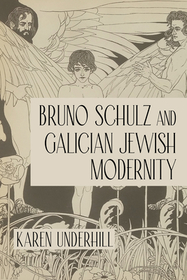
Bruno Schulz and Galician Jewish Modernity
Series: Jews of Eastern Europe;
- Publisher's listprice GBP 64.00
-
28 896 Ft (27 520 Ft + 5% VAT)
The price is estimated because at the time of ordering we do not know what conversion rates will apply to HUF / product currency when the book arrives. In case HUF is weaker, the price increases slightly, in case HUF is stronger, the price goes lower slightly.
- Discount 20% (cc. 5 779 Ft off)
- Discounted price 23 117 Ft (22 016 Ft + 5% VAT)
- Discount is valid until: 30 June 2026
Subcribe now and take benefit of a favourable price.
Subscribe
28 896 Ft

Availability
Estimated delivery time: In stock at the publisher, but not at Prospero's office. Delivery time approx. 3-5 weeks.
Not in stock at Prospero.
Why don't you give exact delivery time?
Delivery time is estimated on our previous experiences. We give estimations only, because we order from outside Hungary, and the delivery time mainly depends on how quickly the publisher supplies the book. Faster or slower deliveries both happen, but we do our best to supply as quickly as possible.
Product details:
- Publisher Indiana University Press
- Date of Publication 25 June 2024
- Number of Volumes Print PDF
- ISBN 9780253057273
- Binding Hardback
- No. of pages300 pages
- Size 229x152 mm
- Weight 612 g
- Language English
- Illustrations 20 b&w illus. Illustrations, black & white 515
Categories
Long description:
In the 1930s, through the prose of Bruno Schulz (1892–1942), the Polish language became the linguistic raw material for a profound exploration of the modern Jewish experience. Rather than turning away from the language like many of his Galician Jewish colleagues who would choose to write in Yiddish, Schulz used the Polish language to explore his own and his generation's relationship to East European Jewish exegetical tradition, and to deepen his reflection on golus or exile as a condition not only of the individual and of the Jewish community, but of language itself, and of matter. Drawing on new archival discoveries, this study explores Schulz's diasporic Jewish modernism as an example of the creative and also transient poetic forms that emerged on formerly Habsburg territory, at the historical juncture between empire and nation-state.
MoreTable of Contents:
"
Preface
Acknowledgments
Introduction: Bruno Schulz and the Archaeology of Polish Jewish Modernism
1. Leading the Word Out of Its Golus: Jewish Writing in the Polish Vernacular
2. ""A Creation Born of the Longing of Golus"": Schulz's 'E.M. Lilien' and the Art of the Modern Jewish Book
3. The Sunday Seminars of Bruno Schulz and Debora Vogel
4. Sanatorium under the Sign of the Hourglass
5. Acculturation without Assimilation: Polish Contexts for a Translational Poetics
6. ""What Have You Done with the Book?"": The Scriptural Impulse from Idolatrous Iconography to Redemptive Midrash
Notes
Bibliography
Index

