

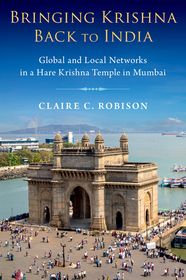
Bringing Krishna Back to India
Global and Local Networks in a Hare Krishna Temple in Mumbai
- Publisher's listprice GBP 78.00
-
35 217 Ft (33 540 Ft + 5% VAT)
The price is estimated because at the time of ordering we do not know what conversion rates will apply to HUF / product currency when the book arrives. In case HUF is weaker, the price increases slightly, in case HUF is stronger, the price goes lower slightly.
- Discount 20% (cc. 7 043 Ft off)
- Discounted price 28 174 Ft (26 832 Ft + 5% VAT)
- Discount is valid until: 30 June 2026
Subcribe now and take benefit of a favourable price.
Subscribe
35 217 Ft

Availability
Estimated delivery time: In stock at the publisher, but not at Prospero's office. Delivery time approx. 3-5 weeks.
Not in stock at Prospero.
Why don't you give exact delivery time?
Delivery time is estimated on our previous experiences. We give estimations only, because we order from outside Hungary, and the delivery time mainly depends on how quickly the publisher supplies the book. Faster or slower deliveries both happen, but we do our best to supply as quickly as possible.
Product details:
- Publisher OUP USA
- Date of Publication 29 August 2024
- ISBN 9780197656457
- Binding Hardback
- No. of pages336 pages
- Size 246x165x30 mm
- Weight 635 g
- Language English
- Illustrations 12, b/w 524
Categories
Short description:
Bringing Krishna Back to India examines the place of the International Society for Krishna Consciousness (ISKCON), in Mumbai, India's business and entertainment capital, where ISKCON draws Indians from diverse regional and religious backgrounds and devotees adopt a conservative religious identity amidst a neoliberal urban context. By inhabiting a Hindu revivalist role, ISKCON educates Hindus and Jains into a new vision of their own traditions and promotes greater religiosity in Indian public life. This contradicts notions that societies are moving towards secularism and highlights how new religious identities are fashioned amidst industrialized urban spaces, such as college campuses, corporate wellness retreats, and Bollywood celebrity events.
MoreLong description:
The Hare Krishnas have long been associated with Western hippie culture and New Age religious movements, but they have also developed deeply rooted communities in India and throughout the world over the past 50 years. Known officially as the International Society for Krishna Consciousness (ISKCON), this once-marginal religious community now wields vast economic assets, political influence, and a posh identity endorsed by Indian business tycoons and Bollywood celebrities.
Bringing Krishna Back to India examines the place of this globalized religious community in Mumbai, India's business and entertainment capital, where ISKCON draws Indians from diverse regional and religious backgrounds and devotees adopt a conservative religious identity amidst a neoliberal urban context. Claire C. Robison examines the full-circle globalization of this religious movement and considers how religious revivalism shifts people's relationships to their religion, family, culture, and nation. By inhabiting a Hindu revivalist role, ISKCON educates Hindus and Jains into a new vision of their own traditions and promotes greater religiosity in Indian public life. This contradicts notions that societies are moving towards secularism and highlights how new religious identities are fashioned amidst industrialized urban spaces, such as college campuses, corporate wellness retreats, and Bollywood celebrity events. It also shows how local religion is shaped by transnational networks-even forms of revivalism that revere premodern ideals. In urban India religious traditionalism is often a form of cosmopolitanism, partaking in neoliberal economies, shaping political trends, and reflecting elite urban aspirations and aesthetics.
In this richly-textured and readable ethnography of the ISKCON community in Mumbai, India, Claire C. Robison offers us an insightful take on the globalization of a religious movement. In exploring how religious revivalism changes people's relationships to their religion, family, culture, and nation, Robison innovatively argues that ISKCON educates Hindus into a new cosmopolitan vision of their own tradition. This provocative and lively lesson in religious originality has applications and implications far beyond India and should be read by all students of religion and globalization.
Table of Contents:
Introduction: The Novelty of Traditionalism: Tracing Global Networks in Local Hindu Revivalism
New Religious Movement, Old Religious Movement: Historicizing a Transnational Organization
Global and Local Networks in a Neighborhood Temple: ISKCON Chowpatty, Mumbai
Crossing Over: Entering the Devotional Family
Ancient Answers to Modern Questions: Revising Religion
Bhakti and Its Boundaries: Enacting a Religious Nation
A New Traditionalism in the City: Transforming Local Culture
Conclusion: Producing a Religious Modernity in Urban India

