

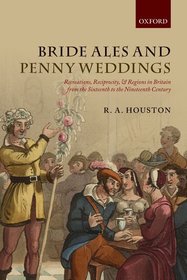
Bride Ales and Penny Weddings
Recreations, Reciprocity, and Regions in Britain from the Sixteenth to the Nineteenth Centuries
- Publisher's listprice GBP 142.50
-
64 338 Ft (61 275 Ft + 5% VAT)
The price is estimated because at the time of ordering we do not know what conversion rates will apply to HUF / product currency when the book arrives. In case HUF is weaker, the price increases slightly, in case HUF is stronger, the price goes lower slightly.
- Discount 10% (cc. 6 434 Ft off)
- Discounted price 57 905 Ft (55 148 Ft + 5% VAT)
Subcribe now and take benefit of a favourable price.
Subscribe
64 338 Ft

Availability
printed on demand
Why don't you give exact delivery time?
Delivery time is estimated on our previous experiences. We give estimations only, because we order from outside Hungary, and the delivery time mainly depends on how quickly the publisher supplies the book. Faster or slower deliveries both happen, but we do our best to supply as quickly as possible.
Product details:
- Publisher OUP Oxford
- Date of Publication 6 March 2014
- ISBN 9780199680870
- Binding Hardback
- No. of pages260 pages
- Size 241x162x26 mm
- Weight 556 g
- Language English
- Illustrations 2 black and white illustrations 0
Categories
Short description:
Looks at regionally distinctive practices of wedding traditions in Britain from the sixteenth to the nineteenth centuries, in order to understand social networks, community attitudes, and local and regional identities.
MoreLong description:
Some of the poorest regions of historic Britain had some of its most vibrant festivities. Between the sixteenth and nineteenth centuries, the peoples of northern England, Lowland Scotland, and Wales used extensive celebrations at events such as marriage, along with reciprocal exchange of gifts, to emote a sense of belonging to their locality. Bride Ales and Penny Weddings looks at regionally distinctive practices of giving and receiving wedding gifts, in order to understand social networks and community attitudes.
Examining a wide variety of sources over four centuries, the volume examines contributory weddings, where guests paid for their own entertainment and gave money to the couple, to suggest a new view of the societies of 'middle Britain', and re-interpret social and cultural change across Britain. These regions were not old fashioned, as is commonly assumed, but differently fashioned, possessing social priorities that set them apart both from the south of England and from 'the Celtic fringe'. This volume is about informal communities of people whose aim was maintaining and enhancing social cohesion through sociability and reciprocity. Communities relied on negotiation, compromise, and agreement, to create and re-create consensus around more-or-less shared values, expressed in traditions of hospitality and generosity. Ranging across issues of trust and neighbourliness, recreation and leisure, eating and drinking, order and authority, personal lives and public attitudes, R. A. Houston explores many areas of interest not only to social historians, but also literary scholars of the British Isles.
This is a richly textured study, full of illuminating comparisons. It is based on extensive research in fascinating primary sources and on very wide secondary reading ... like all the best ground-breaking studies, his book will doubtless stimulate both vigorous debate and further research.
Table of Contents:
Introduction: Marriage and Recreation, Historians, and Social Scientists
PART I: ALES AND BRIDALS: PUBLIC AND PRIVATE SOCIABILITIES
Communal Drinkings in England and Wales, c.1400-1600
Religious Change and the Demise of English Church Ales
Public and Private Festivities: The Geography of Church and Other Ales
PART II: WEDDING CELEBRATIONS IN EARLY MODERN BRITAIN
Weddings in South-East England
Recreations, Religion, and Bridals in Post-Reformation Scotland
Who Held Contributory Weddings and Why?
The Costs and Benefits of Bridals
Country, Town, and the Commercial Element in Hospitality
The Social Universe of Contributory Weddings
Numbers
PART III: COERCION AND THE LIMITS OF VOLUNTARISM
Lovedargs, Boon Days, and Boon Works
Thigging
Cymorthau
PART IV: CONTEXTS AND COMPARISONS
Contempory Explanations of Cultural Change
Regional Socio-Economic Contexts
Cultural Patterns and the 'Celtic Fringe'
Cultural Patterns and Continental Parallels
The Decline of Reciprocity
Conclusion
Bibliography

