

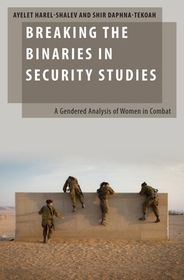
Breaking the Binaries in Security Studies
A Gendered Analysis of Women in Combat
Series: Oxford Studies in Gender and International Relations;
- Publisher's listprice GBP 77.00
-
34 765 Ft (33 110 Ft + 5% VAT)
The price is estimated because at the time of ordering we do not know what conversion rates will apply to HUF / product currency when the book arrives. In case HUF is weaker, the price increases slightly, in case HUF is stronger, the price goes lower slightly.
- Discount 20% (cc. 6 953 Ft off)
- Discounted price 27 812 Ft (26 488 Ft + 5% VAT)
- Discount is valid until: 30 June 2026
Subcribe now and take benefit of a favourable price.
Subscribe
34 765 Ft

Availability
Estimated delivery time: In stock at the publisher, but not at Prospero's office. Delivery time approx. 3-5 weeks.
Not in stock at Prospero.
Why don't you give exact delivery time?
Delivery time is estimated on our previous experiences. We give estimations only, because we order from outside Hungary, and the delivery time mainly depends on how quickly the publisher supplies the book. Faster or slower deliveries both happen, but we do our best to supply as quickly as possible.
Product details:
- Publisher OUP USA
- Date of Publication 24 January 2020
- ISBN 9780190072582
- Binding Hardback
- No. of pages168 pages
- Size 160x239x20 mm
- Weight 408 g
- Language English 0
Categories
Short description:
Drawing on interviews with 100 women soldiers about their experiences in combat, this book asks what insights are gained when we take women's experiences in war as our starting point instead of treating them as "add-ons" to more fundamental or mainstream levels of analysis, and what importance these experiences hold for an analysis of violence and for security studies. The book provides different perspectives about why it is important to explore women in combat, what their experiences teach us, and how to consider soldiers and veterans both as citizens and as violent state actors--an issue with which scholars are often reluctant to engage. Breaking the Binaries in Security Studies raises methodological and theoretical considerations about ways of evaluating power relations in conflict situations and patriarchal structures.
MoreLong description:
Several months after a 2014 operation in the Gaza Strip, fifty-three Israeli Defense Forces combatants and combat-support soldiers were awarded military decorations for exhibiting extraordinary bravery. From a gendered perspective, the most noteworthy aspect of these awards was not the fact that only 4 of the 53 recipients were women, but rather the fact that the men were uniformly praised for being "brave," being "heroes," "actively performing acts of bravery," "protecting," and "preventing terror attacks," while the women were repeatedly commended for "not panicking." This pattern is not unique to the Israeli case, but rather reflects the patriarchal norms that still prevail in military institutions worldwide. One might expect that, now that women serve on the battlefield as combatants, some of the gendered norms informing militaries would have long disappeared. As it stands, women in the military still face a double battle--against the patriarchal institution, as well as against the military's purported enemies.
Drawing on interviews with 100 women military veterans about their experiences in combat, this book asks what insights are gained when we take women's experiences in war as our starting point instead of treating them as "add-ons" to more fundamental or mainstream levels of analysis, and what importance these experiences hold for an analysis of violence and for security studies. Importantly, the authors introduce a theoretical framework in critical security studies for understanding (vis-à-vis binary deconstructions of the terms used in these fields) the integration of women soldiers into combat and combat-support roles, as well as the challenges they face. While the book focuses on women in the Israeli Defence Forces, the book provides different perspectives about why it is important to explore women in combat, what their experiences teach us, and how to consider soldiers and veterans both as citizens and as violent state actors--an issue with which scholars are often reluctant to engage. Breaking the Binaries in Security Studies raises methodological considerations about ways of evaluating power relations in conflict situations and patriarchal structures.
This book fills a gap in knowledge about the roles and experiences of women combatants and raises important questions for future research in international relations, gender and militarism, violence, and critical military studies.
Table of Contents:
Chapter 1 - Women in Combat: A Gendered Perspective
Chapter 2 - Violent State Actors in Feminist Research and Critical Studies
Chapter 3 - Listening to Narratives of Security and In-Security
Chapter 4 - The Politics of Trauma, Gender and War
Chapter 5 - Body, Sex/Gender and Integration of Women into Combat Roles
Chapter 6 - Narratives of Security and In-Security
Appendix
Notes
Bibliography
Index

