

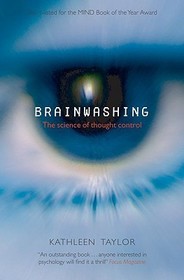
Brainwashing
The science of thought control
- Publisher's listprice GBP 11.99
-
5 413 Ft (5 155 Ft + 5% VAT)
The price is estimated because at the time of ordering we do not know what conversion rates will apply to HUF / product currency when the book arrives. In case HUF is weaker, the price increases slightly, in case HUF is stronger, the price goes lower slightly.
- Discount 10% (cc. 541 Ft off)
- Discounted price 4 871 Ft (4 640 Ft + 5% VAT)
Subcribe now and take benefit of a favourable price.
Subscribe
5 413 Ft

Availability
Out of print
Why don't you give exact delivery time?
Delivery time is estimated on our previous experiences. We give estimations only, because we order from outside Hungary, and the delivery time mainly depends on how quickly the publisher supplies the book. Faster or slower deliveries both happen, but we do our best to supply as quickly as possible.
Product details:
- Edition number New ed
- Publisher Oxford University Press
- Date of Publication 27 July 2006
- ISBN 9780199204786
- Binding Paperback
- No. of pages336 pages
- Size 196x129x24 mm
- Weight 252 g
- Language English
- Illustrations 17 line drawings 0
Categories
Short description:
Bringing together cutting-edge research from psychology and neuroscience, Kathleen Taylor puts the brain back into brainwashing and shows why understanding this mysterious phenomenon is vitally relevant in the twenty-first century.
MoreLong description:
Throughout history, humans have attempted to influence and control the thoughts of others. Since the word 'brainwashing' was coined in the aftermath of the Korean War, it has become part of the popular culture, served as a topic for jokes, and been exploited to create sensational headlines. It has also been the subject of learned discussion from many disciplines: including history, sociology, psychology, and psychotherapy. But until now, a crucial part of the debate
has been missing: that of any serious reference to the science of the human brain. Descriptions of how opinions can be changed, whether by persuasion, deceit, or force, have been almost entirely psychological.
In Brainwashing, Kathleen Taylor brings the worlds of neuroscience and social psychology together for the first time. In elegant and accessible prose, and with abundant use of anecdotes and case-studies, she examines the ethical problems involved in carrying out the required experiments on humans, the limitations of animal models, and the frightening implications of such research. She also explores the history of thought-control and shows how it still exists all around us, from
marketing and television, to politics and education.
An ambitious and well-written study
Table of Contents:
Preface
Part 1: Torture and seduction
The birth of a word
God or the group?
The power of persuasion
Hoping to heal
'I suggest, you persuade, he brainwashes'
Brainwashing and influence
Part 2: The traitor in your skull
Our ever-changing brains
Webs and new worlds
Swept away
The power of stop-and-think
That freedom thing
Part 3: Freedom and control
Victims and predators
Mind factories
Science and nightmare
Taking a stand
Notes
References
Further reading
Glossary
Index

