

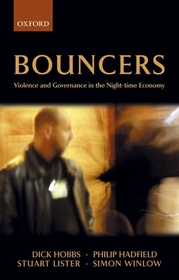
Bouncers
Violence and Governance in the Night-Time Economy
Series: Clarendon Studies in Criminology;
- Publisher's listprice GBP 24.99
-
11 938 Ft (11 370 Ft + 5% VAT)
The price is estimated because at the time of ordering we do not know what conversion rates will apply to HUF / product currency when the book arrives. In case HUF is weaker, the price increases slightly, in case HUF is stronger, the price goes lower slightly.
- Discount 10% (cc. 1 194 Ft off)
- Discounted price 10 745 Ft (10 233 Ft + 5% VAT)
Subcribe now and take benefit of a favourable price.
Subscribe
11 938 Ft

Availability
printed on demand
Why don't you give exact delivery time?
Delivery time is estimated on our previous experiences. We give estimations only, because we order from outside Hungary, and the delivery time mainly depends on how quickly the publisher supplies the book. Faster or slower deliveries both happen, but we do our best to supply as quickly as possible.
Product details:
- Publisher OUP Oxford
- Date of Publication 30 June 2005
- ISBN 9780199288007
- Binding Paperback
- No. of pages336 pages
- Size 215x139x19 mm
- Weight 424 g
- Language English 0
Categories
Short description:
This book is the first attempt to understand Britain's nightime economy, the violence that pervades it, and the bouncers whose job it is to prevent it. Walk down any high street after dark and the shadows of bouncers will loom large, for they are the most visible form of control available in the youth orientated zones of our cities. Britain's rapidly expanding night- life is one of its most vibrant economic spheres, but it has created huge problems of violence and disorder. Using ethnography, participant observation and extensive interviews, this controversial book charts the emergence of bouncers as one of the most graphic symbols in the iconography of post industrial Britain.
MoreLong description:
In recent years, the expansion of night-time leisure has emerged as a key indicator of post-industrial urban prosperity, attracting investment, creating employment and re-generating the built environment.
These leisure economies are youth-dominated, focusing upon the sale and consumption of alcohol. Unprecedented numbers of young people now flock to town centres that are crammed with bars, pubs and clubs, and the resulting violent disorder has over run police resources that remain geared to the drinking patterns and alcohol cultures of previous generations.
Post-industrial re-structuring has spawned an increasingly complex mass of night-time leisure options through which numerous licit and illicit commercial opportunities flow. Yet, regardless of the fashionable and romantic notions of many contemporary urban theorists, it is alcohol, mass intoxication and profit rather than 'cultural regeneration,' which lies at the heart of this rapidly expanding dimension of post-industrial urbanism.
Private security in the bulky form of bouncers fills the void left by the public police. These men (only 7% are women), whose activities are barely regulated by the State, are dominated by a powerful subculture rooted in routine violence and intimidation. Using ethnography, participant observation and extensive interviews with all the main players, this controversial book charts the emergence of the bouncer as one of the most graphic symbols in the iconography of post industrial Britain.
Review from previous edition Hobbs is without doubt Britain's most insightful and penetrating criminological ethnographer, and he uses his skill to provide an extremely useful service...my advice to all interested academics and students is to get a copy, read it, and keep it as a principal guide book to take with you on your theoretical excursions into the subject of professional crime.
Table of Contents:
Let the Good Times Roll: Liminality and the Night-Time Economy
After-Dark 'Fun' and its Control in the Industrial City
Post-Industrial Manchester: From Cotton to Carlsberg
Tommy Smith's Story: Four Decades on the Door
A Word at the Door: Bouncers On Their Work
Manners Maketh the Man: Licensing 'Door Supervisors' and the Discourses of Professionalism and Safety
Market Force: Class, Violence, and Liminal Buiness on the Night-Time Frontier
Night Futures: The Marketization of License and Control
Big People, Dirty Work; A Conclusion

