

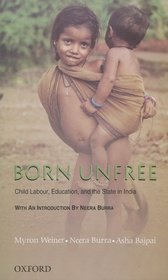
Born Unfree
Child Labour, Education, and the State
- Publisher's listprice GBP 18.99
-
8 573 Ft (8 165 Ft + 5% VAT)
The price is estimated because at the time of ordering we do not know what conversion rates will apply to HUF / product currency when the book arrives. In case HUF is weaker, the price increases slightly, in case HUF is stronger, the price goes lower slightly.
- Discount 10% (cc. 857 Ft off)
- Discounted price 7 716 Ft (7 349 Ft + 5% VAT)
Subcribe now and take benefit of a favourable price.
Subscribe
8 573 Ft

Availability
Uncertain availability. Please turn to our customer service.
Why don't you give exact delivery time?
Delivery time is estimated on our previous experiences. We give estimations only, because we order from outside Hungary, and the delivery time mainly depends on how quickly the publisher supplies the book. Faster or slower deliveries both happen, but we do our best to supply as quickly as possible.
Product details:
- Publisher OUP India
- Date of Publication 30 November 2006
- ISBN 9780195679908
- Binding Hardback
- No. of pages740 pages
- Size 222x147x40 mm
- Weight 932 g
- Language English 0
Categories
Short description:
It has been twenty years since the Indian Parliament passed the Child Labour (Prohibition and Regulation) Act, 1986. Yet more children work as labourers in India than in any other country in the world.
MoreLong description:
It has been twenty years since the Indian Parliament passed the Child Labour (Prohibition and Regulation) Act, 1986. Yet more children work as labourers in India than in any other country in the world. This Omnibus brings together three significant works on child labour focusing on the key factors which create an exploitative relationship between the economy and the children of the poor and the marginalized.
In an Introduction written especially for this Omnibus, Neera Burra points out that there are definitional issues around the very concept of child labour and suggests that insights from feminist economics can help illuminate them; only then can we form an accurate picture of the role of child labour in the economy. In addition, she examines the strategy of different groups who have successfully worked against child labour. She argues that child labour can only be reduced when civil society and
the state work together to get children out of work and into school.
In The Child and the State, Myron Weiner argues that it is not India's poverty which prevents the introduction of universal primary education and the banning of child labour, rather it is lack of political will and the 'belief systems' prevalent in Indian society.
Born to Work is based on first-hand field investigations into the employment of child labour in five industries: brassware, gem polishing, lock-making, pottery, and glass manufacture. Neera Burra documents the hazards that these children face and argues that working from a young age leads to a shortened working life. Thus, child labour is not only a consequence of poverty, but also a major cause of it.
In Child Rights in India, Asha Bajpai provides a detailed overview of the rights of the child in domestic and international law, with a detailed analysis of case law. The chapter excerpted here is devoted to the 'Right Against Economic Exploitation' and includes an examination of various government schemes and NGO interventions, as well as testimonies from children who work as domestic labourers.

