

- Publisher's listprice GBP 93.00
-
41 989 Ft (39 990 Ft + 5% VAT)
The price is estimated because at the time of ordering we do not know what conversion rates will apply to HUF / product currency when the book arrives. In case HUF is weaker, the price increases slightly, in case HUF is stronger, the price goes lower slightly.
- Discount 10% (cc. 4 198 Ft off)
- Discounted price 37 791 Ft (35 991 Ft + 5% VAT)
Subcribe now and take benefit of a favourable price.
Subscribe
41 989 Ft

Availability
Estimated delivery time: In stock at the publisher, but not at Prospero's office. Delivery time approx. 3-5 weeks.
Not in stock at Prospero.
Why don't you give exact delivery time?
Delivery time is estimated on our previous experiences. We give estimations only, because we order from outside Hungary, and the delivery time mainly depends on how quickly the publisher supplies the book. Faster or slower deliveries both happen, but we do our best to supply as quickly as possible.
Product details:
- Publisher OUP USA
- Date of Publication 27 April 2017
- ISBN 9780190627560
- Binding Hardback
- No. of pages200 pages
- Size 234x156x12 mm
- Weight 463 g
- Language English
- Illustrations 3 halftones 0
Categories
Short description:
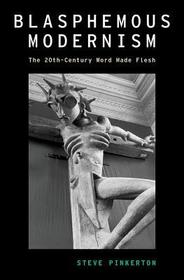
Blasphemous Modernism argues that blasphemy is a signal mode of modernist literary expression. Reading a diverse range of poets (Mina Loy, Langston Hughes) and novelists (James Joyce, Djuna Barnes, Salman Rushdie), Pinkerton shows how these writers forged the literature of modernism from the idiom of blasphemy.
MoreLong description:
Scholars have long described modernism as "heretical" or "iconoclastic" in its assaults on secular traditions of form, genre, and decorum. Yet critics have paid surprisingly little attention to the related category of blasphemy--the rhetoric of religious offense--and to the specific ways this rhetoric operates in, and as, literary modernism. United by a shared commitment to "the word made flesh," writers such as James Joyce, Mina Loy, Richard Bruce Nugent, and Djuna Barnes made blasphemy a key component of their modernist practice, profaning the very scriptures and sacraments that fueled their art. In doing so they belied T. S. Eliot's verdict that the forces of secularization had rendered blasphemy obsolete in an increasingly godless century ("a world in which blasphemy is impossible"); their poems and fictions reveal how forcefully religion endured as a cultural force after the Death of God. Blasphemy respects no division of church and state, and neither do the writers who wield it to profane coercive dogmas--including ecclesiastical and terrestrial ideologies of race, class, nation, empire, gender, and sexuality. The late-century example of Salman Rushdie's The Satanic Verses affords, finally, a demonstration of how modernism persists in postwar Anglophone literature and of the critical role blasphemy plays in that persistence. The transgressions of these writers spotlight a politics of religion that has seldom engaged the attention of modernist studies. Blasphemous Modernism enriches the scope of modernist scholarship by resonating with broader cultural and ideological concerns.
In its explorations of religion and blasphemy, Steve Pinkerton's Blasphemous Modernism: The 20th-Century Word Made Flesh interrogates and challenges common understandings of the period as uninterested in religion's primacy: it 'attends to the complex relationship in modernist texts between words, the Word, and the flesh'. Most compellingly, Pinkerton points to the ways that 'blasphemy is a barometer and a mechanism of power, a discourse governed by the powerful but also occasionally usurped by the marginalized in politically significant ways'
Table of Contents:
Contents
Introduction: “First-Rate Blasphemy”
1. “For This is My Body”: James Joyce's Unholy Office
2. Blasphemy and the New Woman: Mina Loy's Profane Communions
3. Blasphemy and the New Negro: Black Christs, “Livid Tongues”
4. Go Down, Djuna: The Art of “Transcendence Downward”
Conclusion: To Be as Gods
Bibliography

