

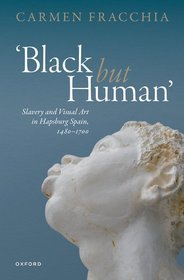
'Black but Human'
Slavery and Visual Art in Hapsburg Spain, 1480-1700
- Publisher's listprice GBP 35.99
-
16 249 Ft (15 475 Ft + 5% VAT)
The price is estimated because at the time of ordering we do not know what conversion rates will apply to HUF / product currency when the book arrives. In case HUF is weaker, the price increases slightly, in case HUF is stronger, the price goes lower slightly.
- Discount 10% (cc. 1 625 Ft off)
- Discounted price 14 624 Ft (13 928 Ft + 5% VAT)
Subcribe now and take benefit of a favourable price.
Subscribe
16 249 Ft

Availability
Estimated delivery time: In stock at the publisher, but not at Prospero's office. Delivery time approx. 3-5 weeks.
Not in stock at Prospero.
Why don't you give exact delivery time?
Delivery time is estimated on our previous experiences. We give estimations only, because we order from outside Hungary, and the delivery time mainly depends on how quickly the publisher supplies the book. Faster or slower deliveries both happen, but we do our best to supply as quickly as possible.
Product details:
- Publisher OUP Oxford
- Date of Publication 28 February 2023
- ISBN 9780198881063
- Binding Paperback
- No. of pages256 pages
- Size 239x156x14 mm
- Weight 480 g
- Language English
- Illustrations 63 colour, 27 b/w, plus 16pp colour plate section 266
Categories
Short description:
'Black but Human' is a proverb which emerges from the African work songs and poems written by Afro-Hispanics enslaved in Spain during the Hapsburg dynasty. Carmen Fracchia uses the lens of visuals arts and material culture to understand the representation and self-representation of Afro-Hispanic slaves and ex-slaves in this period.
MoreLong description:
'Black but Human' is the first study to focus on the visual representations of African slaves and ex-slaves in Spain during the Hapsburg dynasty. The Afro-Hispanic proverb 'Black but Human' is the main thread of the six chapters and serves as a lens through which to explore the ways in which a certain visual representation of slavery both embodies and reproduces hegemonic visions of enslaved and liberated Africans, and at the same time provides material for critical and emancipatory practices by Afro-Hispanics themselves.
The African presence in the Iberian Peninsula between the late fifteenth century and the end of the seventeenth century was as a result of the institutionalization of the local and transatlantic slave trades. In addition to the Moors, Berbers, and Turks born as slaves, there were approximately two million enslaved people in the kingdoms of Castile, Aragón, and Portugal. The 'Black but Human' topos that emerges from the African work songs and poems written by Afro-Hispanics encodes the multi-layered processes through which a black emancipatory subject emerges and a 'black nation' forges a collective resistance. It is visually articulated by Afro-Hispanic and Spanish artists in religious paintings and in the genres of self-portraiture and portraiture. This extraordinary imagery coexists with the stereotypical representations of African slaves and ex-slaves by Spanish sculptors, engravers, jewellers, and painters mainly in the religious visual form and by European draftsmen and miniaturists, in their landscape drawings, and sketches for costume books.
The visual and textual evidence that it assembles will be of substantial interest to those who study the history of race and colour in visual culture, and its original framing opens the way to those who will wish to take its arguments further.
Table of Contents:
Introduction
'Black but Human'
What Is Human About Slavery?
Visual Culture and Slavery
Props and Costume
Commodification: 'Is There Any Caste Lower Than Blacks and Slaves From Guinea?'
The Image of Freedom: 'All Souls Are Of A Single Colour and They Are Wrought In The Same Workshop'
Conclusion

