

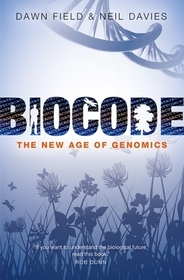
Biocode
The New Age of Genomics
- Publisher's listprice GBP 12.99
-
5 864 Ft (5 585 Ft + 5% VAT)
The price is estimated because at the time of ordering we do not know what conversion rates will apply to HUF / product currency when the book arrives. In case HUF is weaker, the price increases slightly, in case HUF is stronger, the price goes lower slightly.
- Discount 10% (cc. 586 Ft off)
- Discounted price 5 278 Ft (5 027 Ft + 5% VAT)
Subcribe now and take benefit of a favourable price.
Subscribe
5 864 Ft

Availability
printed on demand
Why don't you give exact delivery time?
Delivery time is estimated on our previous experiences. We give estimations only, because we order from outside Hungary, and the delivery time mainly depends on how quickly the publisher supplies the book. Faster or slower deliveries both happen, but we do our best to supply as quickly as possible.
Product details:
- Publisher OUP Oxford
- Date of Publication 25 August 2016
- ISBN 9780199687763
- Binding Paperback
- No. of pages208 pages
- Size 195x139x12 mm
- Weight 160 g
- Language English
- Illustrations 9 black and white illustrations 60
Categories
Short description:
In Biocode, Dawn Field and Neil Davies capture the scale and excitement of the rapidly growing field of genomics. From automatic DNA sequencing of newborns to synthetic life, and the sequencing of whole ecosystems, genomics is set to revolutionize our understanding of life on Earth and affect us all.
MoreLong description:
The living world runs on genomic software - what Dawn Field and Neil Davies call the 'biocode' - the sum of all DNA on Earth. In Biocode, they tell the story of a new age of scientific discovery: the growing global effort to read and map the biocode, and what that might mean for the future. The structure of DNA was identified in 1953, and the whole human genome was mapped by 2003. Since then the new field of genomics has mushroomed and is now operating on an industrial scale. Genomes can now be sequenced rapidly and increasingly cheaply. The genomes of large numbers of organisms from mammals to microbes, have been mapped. Getting your genome sequenced is becoming affordable for many. You too can check paternity, find out where your ancestors came from, or whether you are at risk of some diseases. Some check out the pedigree of their pets, while others turn genomes into art. A stray hair is enough to crudely reconstruct the face of the owner. From reading to constructing: the first steps to creating artificial life have already been taken.
Some may find the rapidity of developments, and the potential for misuse, alarming. But they also open up unprecedented possibilities. The ability to read DNA has changed how we view ourselves and understand our place in nature. From the largest oceans, to the insides of our guts, we are able to explore the biosphere as never before, from the genome up. Sequencing technology has made the invisible world of microbes visible, and biodiversity genomics is revealing whole new worlds within us and without. The findings are transformational: we are all ecosystems now. Already the first efforts at 'barcoding' entire ecological communities and creating 'genomic observatories' have begun. The future, the authors argue, will involve biocoding the entire planet.
Review from previous edition Biocode provides a very readable overview of the broad impact of genomics on our understanding of life. I recommended it to readers of all levels with a love or fascination of science.
Table of Contents:
D.N.A
Personal Genomics
Homo evolutis
Zoo in My Sequencer
No Organism is an Island
Terra-genoming
We are all Ecosystems Now
Biocoding the Earth
References
Further Reading
Index

