

- Publisher's listprice GBP 9.99
-
4 510 Ft (4 295 Ft + 5% VAT)
The price is estimated because at the time of ordering we do not know what conversion rates will apply to HUF / product currency when the book arrives. In case HUF is weaker, the price increases slightly, in case HUF is stronger, the price goes lower slightly.
- Discount % (cc. 0 Ft off)
- Discounted price 0 Ft (0 Ft + 5% VAT)
Subcribe now and take benefit of a favourable price.
Subscribe
4 510 Ft

Availability
Estimated delivery time: In stock at the publisher, but not at Prospero's office. Delivery time approx. 3-5 weeks.
Not in stock at Prospero.
Why don't you give exact delivery time?
Delivery time is estimated on our previous experiences. We give estimations only, because we order from outside Hungary, and the delivery time mainly depends on how quickly the publisher supplies the book. Faster or slower deliveries both happen, but we do our best to supply as quickly as possible.
Product details:
- Publisher OUP Oxford
- Date of Publication 23 November 2017
- ISBN 9780198779575
- Binding Paperback
- No. of pages160 pages
- Size 172x110x8 mm
- Weight 134 g
- Language English
- Illustrations 18 black and white images 0
Categories
Short description:
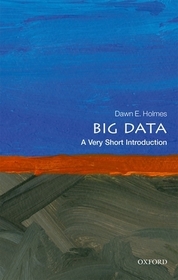
An unimaginably vast amount of data is now generated by our on-line lives and businesses, At the same time, our ability to store, manage, analyse, and exploit this data is becoming ever more sophisticated. This Very Short Introduction maps out the technology, and also the range of possibilities, challenges, and ethical questions it raises.
MoreLong description:
Since long before computers were even thought of, data has been collected and organized by diverse cultures across the world. Once access to the Internet became a reality for large swathes of the world's population, the amount of data generated each day became huge, and continues to grow exponentially. It includes all our uploaded documents, video, and photos, all our social media traffic, our online shopping, even the GPS data from our cars.
'Big Data' represents a qualitative change, not simply a quantitative one. The term refers both to the new technologies involved, and to the way it can be used by business and government. Dawn E. Holmes uses a variety of case studies to explain how data is stored, analysed, and exploited by a variety of bodies from big companies to organizations concerned with disease control. Big data is transforming the way businesses operate, and the way medical research can be carried out. At the same time, it raises important ethical issues; Holmes discusses cases such as the Snowden affair, data security, and domestic smart devices which can be hijacked by hackers.
ABOUT THE SERIES: The Very Short Introductions series from Oxford University Press contains hundreds of titles in almost every subject area. These pocket-sized books are the perfect way to get ahead in a new subject quickly. Our expert authors combine facts, analysis, perspective, new ideas, and enthusiasm to make interesting and challenging topics highly readable.
Big data is in the news, and this excellent very short introduction brings the reader up to speed and enables them to understand the various components and implications.
Table of Contents:
The data explosion
Why is big data special?
Storing big data
Big data analysis
Big data and medicine
Big data, big business
Big data security and the Snowden case
The internet of things
Byte size chart
References
Further Reading
Index

