

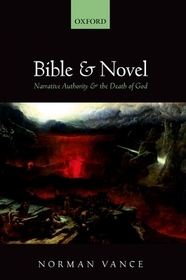
Bible and Novel
Narrative Authority and the Death of God
- Publisher's listprice GBP 135.00
-
60 952 Ft (58 050 Ft + 5% VAT)
The price is estimated because at the time of ordering we do not know what conversion rates will apply to HUF / product currency when the book arrives. In case HUF is weaker, the price increases slightly, in case HUF is stronger, the price goes lower slightly.
- Discount 10% (cc. 6 095 Ft off)
- Discounted price 54 857 Ft (52 245 Ft + 5% VAT)
Subcribe now and take benefit of a favourable price.
Subscribe
60 952 Ft

Availability
printed on demand
Why don't you give exact delivery time?
Delivery time is estimated on our previous experiences. We give estimations only, because we order from outside Hungary, and the delivery time mainly depends on how quickly the publisher supplies the book. Faster or slower deliveries both happen, but we do our best to supply as quickly as possible.
Product details:
- Publisher OUP Oxford
- Date of Publication 4 July 2013
- ISBN 9780199680573
- Binding Hardback
- No. of pages246 pages
- Size 225x166x21 mm
- Weight 450 g
- Language English 0
Categories
Short description:
This study seeks to develop a new context for reading later Victorian fiction and for understanding the process of 'secularization'. Norman Vance explores how the novels of George Eliot, Thomas Hardy, Mary Ward, and Rider Haggard acquired greater cultural centrality, just as the authority of the scriptures and of traditional religious teaching seemed to be declining, and offered a new forum for the exploration of religious and moral themes.
MoreLong description:
The Victorian novel acquired greater cultural centrality just as the authority of the scriptures and of traditional religious teaching seemed to be declining. Did the novel supplant the Bible? The novelists often adopted or participated in a broadly progressive narrative of social change which can be seen as a secular replacement for the theological narrative of 'salvation history' and the waning authority of biblical narrative. Victorian fiction seems in some ways to enact the process of secularization. But contemporary religious resurgence in various parts of the world and postmodern scepticism about grand narratives have challenged and complicated the conventional view of secularization as an irreversible process, an inevitable 'disenchantment of the world' which is an aspect and function of the grand narrative of modernization. Such developments raise new questions about apparently post-Christian Victorian fiction.
In our increasingly secular society novel-reading is now more popular than Bible-reading. Serious novels are often taken more seriously than scripture. Norman Vance looks at how this may have come about as an introduction to four best-selling late-Victorian novelists: George Eliot, Thomas Hardy, Mary Ward and Rider Haggard. Does the novel in their hands take the place of the Bible? Can apparently secular novels still have religious significance? Can they make new imaginative sense of some of the religious and moral themes and experiences to be found in the Bible? Do Eliot and her successors anticipate some of the insights of modern theology and contemporary investigations of religious experience? Do they call in question long-standing rumours of the death of God and the triumph of the secular?
Bible and Novel develops a new context for reading later Victorian fiction, using it to illuminate the increasingly perplexed and confusing issue of 'secularization' and recent negotiations of the 'post-secular'.
this book is engaging, informed and ambitious yet controlled ... effectively raise[s] the question of whether secularization is an accurate or useful way to understand either literature or history.
Table of Contents:
God and the Bible, Secularisms and Novels
The Authority of the Bible
The Crisis of Biblical Authority
George Eliot s Secular Scriptures
Thomas Hardy: the Church and the Negation of Christianity
Mary Ward and the Problems of History
Rider Haggard: Adventures with the Numinous
Conclusion: Authority, the Novel and God

