

-
GET 10% OFF
- Publisher's listprice GBP 155.00
-
69 982 Ft (66 650 Ft + 5% VAT)
The price is estimated because at the time of ordering we do not know what conversion rates will apply to HUF / product currency when the book arrives. In case HUF is weaker, the price increases slightly, in case HUF is stronger, the price goes lower slightly.
- Discount 10% (cc. 6 998 Ft off)
- Discounted price 62 984 Ft (59 985 Ft + 5% VAT)
62 984 Ft

Availability
Estimated delivery time: In stock at the publisher, but not at Prospero's office. Delivery time approx. 3-5 weeks.
Not in stock at Prospero.
Why don't you give exact delivery time?
Delivery time is estimated on our previous experiences. We give estimations only, because we order from outside Hungary, and the delivery time mainly depends on how quickly the publisher supplies the book. Faster or slower deliveries both happen, but we do our best to supply as quickly as possible.
Product details:
- Edition number 1
- Publisher Routledge
- Date of Publication 29 May 2026
- ISBN 9781041251927
- Binding Hardback
- No. of pages310 pages
- Size 234x156 mm
- Weight 730 g
- Language English
- Illustrations 9 Illustrations, black & white; 9 Line drawings, black & white; 3 Tables, black & white 691
Categories
Short description:
This volume challenges the assumption that dominant water-management solutions are universally effective, neutral and scientifically validated. This book is essential reading for students, academics and professionals in water policy, water governance and environmental management more broadly.
MoreLong description:
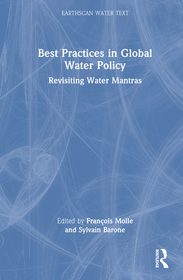
This volume challenges the assumption that dominant water-management solutions are universally effective, neutral and scientifically validated.
Global water policy tends to frame certain concepts and tools – such as river basin organisations, water pricing, drip irrigation, nature-based solutions and wastewater reuse – as ‘best practices’. These ready-made solutions, endorsed by policymakers, development agencies and experts, are widely disseminated across countries with limited critical scrutiny. This book examines how these dominant solutions, while often appearing rational and evidence-based, can obscure trade-offs, negative externalities and unintended consequences. From irrigation modernisation projects that inadvertently increase water consumption due to the rebound effect to water user associations that fail to address deeper governance and equity issues, this book engages with 20 ‘best practices’ to illustrate how universal solutions often ignore the complexity of water politics, institutional settings, cultural specificities and ecological realities. While not dismissing the value of best practices outright, this book argues for a more sceptical, politically aware and context-sensitive approach to water management. It calls for a shift in the burden of proof: rather than accepting a best practice as effective unless proven otherwise, water governance should start by scrutinising the potential externalities, risks and limitations of any proposed intervention.
This book is essential reading for students, academics and professionals in water policy, water governance and environmental management more broadly.
MoreTable of Contents:
1. Introduction: Engaging with water policy best practices 2. Revisiting – Drip irrigation will save water 3. Revisiting – Reusing treated wastewater: an alternative water to reduce scarcity 4. Revisiting – Desalination: the new and inexhaustible water source 5. Revisiting – Large-dam water storage is unavoidable or an anathema 6. Revisiting – Water harvesting is necessary to enhance local supply 7. Revisiting – Abstracting groundwater is safe as long as you pump less than the natural recharge 8. Revisiting – Planting trees will sustain springs and streamflow 9. Revisiting – Pricing irrigation water will reduce its use 10. Revisiting – Payment for environmental services is a win-win 11. Revisiting – Making space for water 12. Revisiting – River weirs are obstacles that must be removed 13. Revisiting – Environmental flows are necessary to safeguard nature 14. Revisiting – Rivers should be restored to their “natural” state 15. Revisiting – All water uses can be reconciled while protecting the environment 16. Revisiting – A river basin begs a river basin organisation 17. Revisiting – Collective action needs water user associations 18. Revisiting – The myth of private finance and SDG6 19. Revisiting – Private water services are more efficient and reliable 20. Revisiting – “Off-grid is cool”: virtuous non-connection to water networks 21. Revisiting – Rivers should have legal rights 22. Conclusion: Revisiting global water mantras
More
