

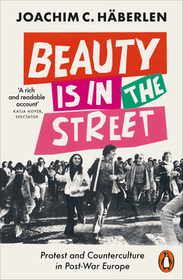
Beauty is in the Street
Protest and Counterculture in Post-War Europe
-
GET 20% OFF
- Publisher's listprice GBP 12.99
-
5 864 Ft (5 585 Ft + 5% VAT)
The price is estimated because at the time of ordering we do not know what conversion rates will apply to HUF / product currency when the book arrives. In case HUF is weaker, the price increases slightly, in case HUF is stronger, the price goes lower slightly.
- Discount 20% (cc. 1 173 Ft off)
- Discounted price 4 691 Ft (4 468 Ft + 5% VAT)
- Discount is valid until: 31 May 2026
4 691 Ft

Availability
Uncertain availability. Please turn to our customer service.
Why don't you give exact delivery time?
Delivery time is estimated on our previous experiences. We give estimations only, because we order from outside Hungary, and the delivery time mainly depends on how quickly the publisher supplies the book. Faster or slower deliveries both happen, but we do our best to supply as quickly as possible.
Product details:
- Publisher Penguin Books Ltd
- Date of Publication 3 October 2024
- Number of Volumes B-format paperback
- ISBN 9780141994963
- Binding Paperback
- No. of pages512 pages
- Size 197x131x23 mm
- Weight 351 g
- Language English 0
Categories
Long description:
'A rich and readable account of left-wing activism in the West and opposition to Soviet-style communism in the East' Katja Hoyer, The Spectator
'A dream, perhaps, but one that still sounds worth fighting for, even beautiful' Stuart Jeffries, The Observer
'An ambitious and masterly account of utopian protest in Europe ... Fast-paced, with an eye for telling detail and written with a light touch' Robert Gildea
In post-war Europe, protest was everywhere. On both sides of the Iron Curtain, from Paris to Prague, Milan to Wroclaw, ordinary people took to the streets, fighting for a better world. Their efforts came to a head most dramatically in 1968 and 1989, when mass movements swept Europe and rewrote its history.
In the decades between, Joachim C. Häberlen argues, new movements emerged that transformed the nature of protesting. Activism moved beyond traditional demonstrations, from squatting to staging 'happenings' and camping out at nuclear power plants. People protested in the way they dressed, the music they listened to, the lovers they slept with, the clubs where they danced all night. New movements were born, notably anti-racism, women's liberation, gay liberation, and environmentalism. And protest turned inward, as activists experimented with new ways of living and feeling, from communes to group therapy, in their efforts to live a better life in the here and now.
Some of these struggles succeeded, others failed. But successful or not, their history provides a glimpse into roads not taken, into futures that did not happen. The stories in Häberlen's book invite us to imagine different futures; to struggle, to fail, and to try again. In a time when we are told that there are no alternatives, they show us that there could be another way.

