

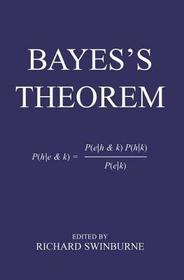
Bayes's Theorem
Series: Proceedings of the British Academy; 113;
- Publisher's listprice GBP 20.00
-
9 030 Ft (8 600 Ft + 5% VAT)
The price is estimated because at the time of ordering we do not know what conversion rates will apply to HUF / product currency when the book arrives. In case HUF is weaker, the price increases slightly, in case HUF is stronger, the price goes lower slightly.
- Discount 10% (cc. 903 Ft off)
- Discounted price 8 127 Ft (7 740 Ft + 5% VAT)
Subcribe now and take benefit of a favourable price.
Subscribe
9 030 Ft

Availability
Estimated delivery time: In stock at the publisher, but not at Prospero's office. Delivery time approx. 3-5 weeks.
Not in stock at Prospero.
Why don't you give exact delivery time?
Delivery time is estimated on our previous experiences. We give estimations only, because we order from outside Hungary, and the delivery time mainly depends on how quickly the publisher supplies the book. Faster or slower deliveries both happen, but we do our best to supply as quickly as possible.
Product details:
- Publisher The British Academy
- Date of Publication 12 May 2005
- ISBN 9780197263419
- Binding Paperback
- No. of pages160 pages
- Size 234x157x4 mm
- Weight 312 g
- Language English
- Illustrations 3 tables, 3 figures 0
Categories
Short description:
Bayes's theorem is a tool for assessing how probable evidence makes some hypothesis. The papers in this volume consider the worth and applicability of the theorem. Richard Swinburne sets out the philosophical issues. Elliott Sober argues that there are other criteria for assessing hypotheses. Colin Howson, Philip Dawid and John Earman consider how the theorem can be used in statistical science, in weighing evidence in criminal trials, and in assessing evidence for the occurrence of miracles. David Miller argues for the worth of the probability calculus as a tool for measuring propensities in nature rather than the strength of evidence. The volume ends with the original paper containing the theorem, presented to the Royal Society in 1763.
MoreLong description:
Bayes's theorem is a tool for assessing how probable evidence makes some hypothesis. The papers in this volume consider the worth and applicability of the theorem. Richard Swinburne sets out the philosophical issues. Elliott Sober argues that there are other criteria for assessing hypotheses. Colin Howson, Philip Dawid and John Earman consider how the theorem can be used in statistical science, in weighing evidence in criminal trials, and in assessing evidence for the occurrence of miracles. David Miller argues for the worth of the probability calculus as a tool for measuring propensities in nature rather than the strength of evidence. The volume ends with the original paper containing the theorem, presented to the Royal Society in 1763.
MoreTable of Contents:
- Introduction
- Bayesianism - its scopes and limits
- Bayesianism in Statistics
- Bayes's Theorem and Weighing Evidence by Juries
- Bayes, Hume, Price, and Miracles
- Propensities May Satisfy Bayes's Theorem
- 'An Essay Towards Solving a Problem in the Doctrine of Chances' by Thomas Bayes, presented to the Royal Society by Richard Price. Preceded by a historical introduction by G A Barnard.

