

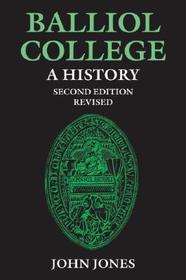
Balliol College: A History, Second Edition
REISSUE, WITH REVISIONS
- Publisher's listprice GBP 96.00
-
43 344 Ft (41 280 Ft + 5% VAT)
The price is estimated because at the time of ordering we do not know what conversion rates will apply to HUF / product currency when the book arrives. In case HUF is weaker, the price increases slightly, in case HUF is stronger, the price goes lower slightly.
- Discount 10% (cc. 4 334 Ft off)
- Discounted price 39 010 Ft (37 152 Ft + 5% VAT)
Subcribe now and take benefit of a favourable price.
Subscribe
43 344 Ft

Availability
Permanently out of stock
Why don't you give exact delivery time?
Delivery time is estimated on our previous experiences. We give estimations only, because we order from outside Hungary, and the delivery time mainly depends on how quickly the publisher supplies the book. Faster or slower deliveries both happen, but we do our best to supply as quickly as possible.
Product details:
- Publisher OUP Oxford
- Date of Publication 10 July 1997
- ISBN 9780199201815
- Binding Hardback
- No. of pages392 pages
- Size 244x164x29 mm
- Weight 872 g
- Language English
- Illustrations 31 colour plates + numerous halftone and line illustrations 0
Categories
Short description:
'This is an admirably scholarly work, and a good read too. Its illustrations and plans are well chosen . . . John Jones gives us a great deal of new and detailed information about many aspects of the College's life, and some balanced revisions of traditional judgements. It will remain the standard work for a long time.'
Christopher Hill
Long description:
Balliol College has existed as a community of scholars on its present site without interruption since about 1263. By this token it is the oldest College in Oxford or Cambridge. Balliol men were prominent in the collection of humanist literature in the fifteenth century, and the College was notorious in the century after that for adherence to Rome. Even the relative obscurity of the next two hundred years was occasionally illuminated by famous members such as John Evelyn the diarist (1620-1706) and James Stirling the mathematician (1692-1770). Balliol blazed the trail in the early nineteenth century by introducing a competitive entrance examination, becoming a dominant influence throughout the British Empire in Victorian and Edwardian times. The College's sometime members include many poets and men of letters, heads of government, heads of state, and religious leaders. The first edition (1988) which used much fresh material and was revisionist in its conclusions, ended with the outbreak of war in 1939. The second edition included new detail throughout, a greatly increased number of illustrations, and it brought coverage up to 1996 in an extended Epilogue. The revised second edition has been brought up to 2004 in the extended Epilogue.
These changes ... bring this excellent history up to date and guarantee that its value to historians remains as great as hitherto.
Table of Contents:
The Foundation of the College
Constitutional Change and Expansion in the Fourteenth Century
The Early Members
The Fifteenth Century
Bishop Fox's Statutes
The Second Chapel and the Reformation
Elizabethan Balliol: College Life and Administration
'Suspicion of Papistrie'
The Early Seventeenth Century
The Civil War and Interregnum
Penury and Recovery 1660-1720
People, Life, and Times 1675-1725
The Mastership of Theophilus Leigh
From Obscurity to Pre-eminence 1785-1854
On the Crest of a Wave: Jowett's Balliol
Effortless Superiority 1893-1914
The Great War
Balliol between the Wars
Epilogue
Appendices
Plans of the College Sites and Buildings
Index

