

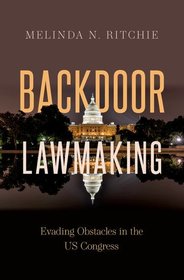
Backdoor Lawmaking
Evading Obstacles in the US Congress
- Publisher's listprice GBP 20.99
-
9 476 Ft (9 025 Ft + 5% VAT)
The price is estimated because at the time of ordering we do not know what conversion rates will apply to HUF / product currency when the book arrives. In case HUF is weaker, the price increases slightly, in case HUF is stronger, the price goes lower slightly.
- Discount 20% (cc. 1 895 Ft off)
- Discounted price 7 581 Ft (7 220 Ft + 5% VAT)
- Discount is valid until: 30 June 2026
Subcribe now and take benefit of a favourable price.
Subscribe
9 476 Ft

Availability
Estimated delivery time: In stock at the publisher, but not at Prospero's office. Delivery time approx. 3-5 weeks.
Not in stock at Prospero.
Why don't you give exact delivery time?
Delivery time is estimated on our previous experiences. We give estimations only, because we order from outside Hungary, and the delivery time mainly depends on how quickly the publisher supplies the book. Faster or slower deliveries both happen, but we do our best to supply as quickly as possible.
Product details:
- Publisher OUP USA
- Date of Publication 28 September 2023
- ISBN 9780197670491
- Binding Paperback
- No. of pages272 pages
- Size 236x156x16 mm
- Weight 404 g
- Language English 441
Categories
Short description:
Civics textbooks focus on how Congress makes policy through the legislative process, but the reality is that members of Congress have limited opportunities to advance their policy priorities. In fact, less than five percent of the bills that are introduced in Congress become law. What strategies do lawmakers have for navigating obstacles in Congress? In this book, Melinda N. Ritchie reveals how members of Congress use the federal bureaucracy as a backdoor for policymaking. Drawing on an original dataset constructed from records obtained under the Freedom of Information Act, Ritchie traces the interactions between members of Congress and federal agencies to illustrate how these communications function as part of a lawmaker's overarching strategy for policymaking.
MoreLong description:
Civics textbooks focus on how Congress makes policy through the legislative process, but the reality is that members of Congress have limited opportunities to advance their policy priorities. In fact, less than five percent of the bills that are introduced in Congress become law. Even the most tenacious legislators are confronted by bicameralism, partisan gridlock, chamber procedures, leadership's control of the agenda, and the diverse interests of 534 other members of Congress. What strategies do lawmakers have for navigating these challenges?
In this book, Melinda N. Ritchie reveals how members of Congress use the federal bureaucracy as a backdoor for policymaking. Today, more law in the United States is made by unelected bureaucrats through federal agency regulations than with congressional statute. Ritchie argues that the bureaucracy's growing role in policymaking offers lawmakers a discreet way to represent controversial interests outside of the formal constraints of Congress. Lawmakers overcome obstacles in the legislative process by substituting agency regulations for legislation and pressuring agencies to make policy changes that would not pass Congress.
Drawing on an original dataset constructed from records obtained under the Freedom of Information Act, Ritchie traces the interactions between members of Congress and federal agencies to illustrate how these communications function as part of a lawmaker's overarching strategy for policymaking. Original and timely, Backdoor Lawmaking explains how members of Congress exploit the separation of powers and evade the lawmaking process established in the US Constitution.
This book lifts the veil on one aspect of the reality of lawmaking in the US...Ritchie's book is an instructive read.
Table of Contents:
Acknowledgments
List of Figures
List of Tables
1. Introduction
2. A Theory of Back-Channel Policymaking
3. The Freedom of Information Act and the War against
Transparency
4. The Nature of Inter-Branch Policy Communication
5. Misconceptions about Inter-Branch Relations
6. The Bureaucracy: Congress's Backdoor to Policy Influence
7. Back-Channel Representation
8. Congressional Access and Influence in the Bureaucracy
9. Conclusion
Notes
Index

