

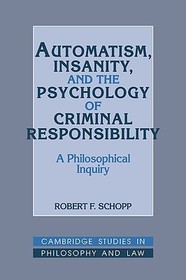
Automatism, Insanity, and the Psychology of Criminal Responsibility
A Philosophical Inquiry
Series: Cambridge Studies in Philosophy and Law;
- Publisher's listprice GBP 110.00
-
49 665 Ft (47 300 Ft + 5% VAT)
The price is estimated because at the time of ordering we do not know what conversion rates will apply to HUF / product currency when the book arrives. In case HUF is weaker, the price increases slightly, in case HUF is stronger, the price goes lower slightly.
- Discount 20% (cc. 9 933 Ft off)
- Discounted price 39 732 Ft (37 840 Ft + 5% VAT)
- Discount is valid until: 30 June 2026
Subcribe now and take benefit of a favourable price.
Subscribe
49 665 Ft

Availability
Estimated delivery time: In stock at the publisher, but not at Prospero's office. Delivery time approx. 3-5 weeks.
Not in stock at Prospero.
Why don't you give exact delivery time?
Delivery time is estimated on our previous experiences. We give estimations only, because we order from outside Hungary, and the delivery time mainly depends on how quickly the publisher supplies the book. Faster or slower deliveries both happen, but we do our best to supply as quickly as possible.
Product details:
- Publisher Cambridge University Press
- Date of Publication 26 July 1991
- ISBN 9780521401500
- Binding Hardback
- No. of pages292 pages
- Size 229x152x21 mm
- Weight 600 g
- Language English 0
Categories
Short description:
This is a book about the role that psychological impairment should play in a theory of criminal liability.
MoreLong description:
This is a book about the role that psychological impairment should play in a theory of criminal liability. Criminal guilt in the Anglo-American legal tradition requires both that the defendant committed some proscribed act and did so with intent, knowledge, or recklessness. The second requirement corresponds to the intuitive idea that people should not be punished for something they did not do 'on purpose' or if they 'did not realize what they were doing'. Unlike many works in this area, this book addresses the automatism and insanity defences by examining the types of functional impairment that typical candidates for these defences actually suffer. What emerges is a much wider conceptual framework that allows us to understand the significance of psychological states and processes for the attribution of criminal responsibility in a manner that is logically coherent, morally defensible, and consistent with research in psychopathology.
"Schopp's book is a collection of treasures, to be slowly and carefully unwrapped. It brings the reader to the heart of current debates in action theory, philosophy of mind, social psychology, and metaphysics. It offers a wealth of jurisprudential data and reflection to the legal philosopher, as well as calling to order the intransigent legal and philosophical categories of liability. But most significantly, it vindicates the philosophical enterprise in the legal context, offering up-to-date solutions to some traditional problems that have vexed and embarrassed both law and philosophy." Canadian Philosophical Reviews
Table of Contents:
Preface; Acknowledgments; 1. Introduction; 2. Problematic defenses: insanity; 3. Problematic defenses: automatism; 4. Actions, reasoning, and offenses; 5. Automatism 6. The insanity defense; 7. Moral foundations; Index.
More
