

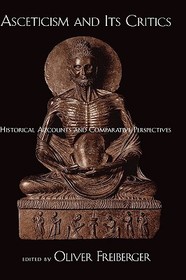
Asceticism and Its Critics
Historical Accounts and Comparative Perspectives
Series: AAR Cultural Criticism Series;
- Publisher's listprice GBP 135.00
-
60 952 Ft (58 050 Ft + 5% VAT)
The price is estimated because at the time of ordering we do not know what conversion rates will apply to HUF / product currency when the book arrives. In case HUF is weaker, the price increases slightly, in case HUF is stronger, the price goes lower slightly.
- Discount 10% (cc. 6 095 Ft off)
- Discounted price 54 857 Ft (52 245 Ft + 5% VAT)
Subcribe now and take benefit of a favourable price.
Subscribe
60 952 Ft

Availability
printed on demand
Why don't you give exact delivery time?
Delivery time is estimated on our previous experiences. We give estimations only, because we order from outside Hungary, and the delivery time mainly depends on how quickly the publisher supplies the book. Faster or slower deliveries both happen, but we do our best to supply as quickly as possible.
Product details:
- Publisher OUP USA
- Date of Publication 26 October 2006
- ISBN 9780195307917
- Binding Hardback
- No. of pages268 pages
- Size 245x159x23 mm
- Weight 540 g
- Language English 0
Categories
Short description:
Scholars of religion have always been fascinated by asceticism. Scholars have often been overlooked, however, that in the history of religions ascetic beliefs and practices have also been strongly criticised, by followers of the same religious tradition as well as by outsiders. The respective sources provide sufficient evidence of such critical strands but surprisingly as yet no attempt has been made to analyse this criticism of asceticism systematically. This book is a first attempt of filling this gap. Ten studies present cases from both Asian and European traditions: classicaland medieval Hinduism, early and contemporary Buddhism in South and East Asia
MoreLong description:
Scholars of religion have always been fascinated by asceticism. Some have even regarded this radical way of life the withdrawal from the world, combined with practices that seriously affect basic bodily needs, up to extreme forms of self-mortification as the ultimate form of a true religious quest. This view is rooted in hagiographic descriptions of prominent ascetics and in other literary accounts that praise the ascetic life-style. Scholars have often overlooked, however, that in the history of religions ascetic beliefs and practices have also been strongly criticized, by followers of the same religious tradition as well as by outsiders. The respective sources provide sufficient evidence of such critical strands but surprisingly as yet no attempt has been made to analyze this criticism of asceticism systematically. This book is a first attempt of filling this gap. Ten studies present cases from both Asian and European traditions: classical and medieval Hinduism, early and contemporary Buddhism in South and East Asia, European antiquity, early and medieval Christianity, and 19th/20th century Aryan religion. Focusing on the critics of asceticism, their motives, their arguments, and the targets of their critique, these studies provide a broad range of issues for comparison. They suggest that the critique of asceticism is based on a worldview differing from and competing with the ascetic worldview, often in one and the same historical context. The book demonstrates that examining the critics of asceticism helps understand better the complexity of religious traditions and their cultural contexts. The comparative analysis, moreover, shows that the criticism of asceticism reflects a religious worldview as significant and widespread in the history of religions as asceticism itself is.
More
